
Let’s establish something at the start so we can’t have any arguments about it later. In 1992, when Shah Rukh Khan arrived in Bollywood, the industry operated almost entirely on nepotism, connections, and who your father knew. Aamir Khan’s father and uncle were both film producers and directors. Salman Khan’s father Salim Khan wrote Sholay and Deewaar — screenplays so legendary they have their own entry in Indian cultural history. These were not minor connections. These were the kind of introductions that meant your first film was a serious production with real budgets and real directors attached.
Shah Rukh Khan’s father ran a mess at the National School of Drama in Delhi and tried several businesses without consistent success. His mother was a magistrate and social worker. Neither parent had a single Bollywood contact. When SRK moved to Mumbai in 1991, he arrived from Delhi with theatre experience, television credits from Fauji and Circus, an economics degree from Hansraj College, and absolutely nobody to call.
In 2025, the Hurun India Rich List placed Shah Rukh Khan’s net worth at ₹12,490 crore — making him not just India’s richest actor but the first Indian actor to enter the billionaire club in rupee terms. He is wealthier than Tom Cruise. He commands ₹150–250 crore per film. His production company Red Chillies Entertainment is valued at over ₹4,500 crore. He owns KKR — an IPL franchise worth over ₹9,000 crore. He owns Mannat, a six-storey sea-facing mansion in Bandra where tourists stop to take photographs of the nameplate.
The man who had nobody to call is now the person everyone in Bollywood wants to call.
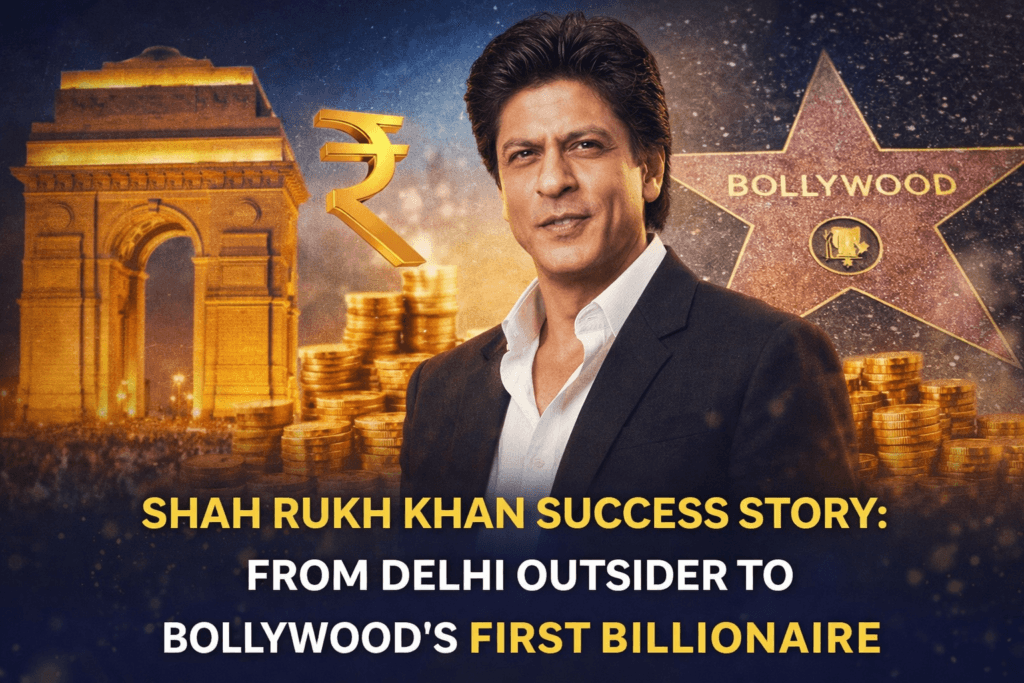
At an event in Riyadh, Salman Khan said SRK came from Delhi and struggled. Shah Rukh corrected him with a smile: “I also come from a film family. Salman’s family is my family, and Aamir’s family is my family. That’s why I’m a star.”
— The most graceful response to the outsider question ever given, delivered without a trace of bitterness
The Delhi Years: Before Anyone Was Watching
Shah Rukh Khan was born on November 2, 1965 in New Delhi. He grew up in Rajendra Nagar, a middle-class neighbourhood, and attended St. Columba’s School — where he won the Sword of Honour, the school’s highest recognition for excellence across academics, sports, and co-curricular activities. He was not a quiet, studious child building credentials on the side. He was loud, mischievous, involved in everything, known across his colony for his energy and his ability to imitate Bollywood actors.
His father Meer Taj Mohammed Khan had been a freedom fighter in his youth — one of the youngest, by family accounts — but never found consistent professional footing. He ran a mess at the National School of Drama, tried transport businesses, and moved between ventures without the kind of stable success that would have given the family financial security. What he did give his son was exposure: through the NSD mess, the young Shah Rukh grew up around theatre artists, absorbed the language of performance, and fell in love with the craft before he fully understood what falling in love with a craft would cost him later.
At Hansraj College, Delhi University, SRK enrolled for economics but spent most of his time at the Delhi Theatre Action Group under the mentorship of theatre director Barry John — a British director who would leave a permanent mark on how SRK understood acting. Barry John didn’t teach him to perform. He taught him to inhabit. There’s a difference, and you can see it in every SRK performance that landed versus the ones that didn’t: the ones that worked were the ones where he believed the character entirely, not the ones where he was showing you the character.
He cleared the IIT entrance exam — his mother insisted — but left before completing his engineering attempt. He began a master’s in mass communication at Jamia Millia Islamia, where a junior named Kabir Khan (later a film director of note) would use SRK’s study notes. He left that too. Not aimlessly — purposefully. The theatre was calling louder than any degree.
The Two Losses That Changed Everything
Tragedy arrived before ambition could fully take shape. Shah Rukh Khan’s father died of cancer when SRK was just 15. His mother — already ill — passed away a few years later, in 1991, when he was 25. By the time he moved to Mumbai to pursue a film career, both parents were gone. He had a sister to support. He had no safety net. He had no industry contacts. And he had a grief that he has spoken about in interviews with a rawness that never quite sounds like it has fully resolved.
He has said publicly that he moved to Mumbai in April 1991, after his mother died, partly because staying in Delhi without her was unbearable. The city had become a container for loss. Mumbai was somewhere else. The film career wasn’t just ambition — it was also escape, transformation, and the kind of forward movement that grief sometimes demands.
He arrived in Mumbai and was quickly signed to four films. Not because of connections — because the television work he’d done had made him visible. Fauji had built a small but genuine fanbase. Directors who saw it saw something they wanted on a bigger screen. His first film, Deewana, cast him as the second male lead behind Rishi Kapoor. It became a box office hit. He won the Filmfare Best Male Debut Award.
The outsider had arrived. Now he had to prove he wasn’t leaving.
The Move That Nobody Understood at the Time
In 1993 — just one year into his film career, when the sensible thing would have been to play heroes and consolidate his debut success — Shah Rukh Khan accepted two villain roles back to back. Darr and Baazigar. Both in the same year. The industry thought he was making a catastrophic mistake. You don’t play villains as a new leading man. You play heroes. You build goodwill. You protect the image.
SRK played an obsessive, murderous stalker in Darr. He played a man who pushes his girlfriend off a building in Baazigar. He played both roles with such unsettling conviction that audiences couldn’t look away. Both films became massive hits. Suddenly he wasn’t just another debut actor — he was the only actor in Bollywood who could make the villain the most compelling person in the room and still have women in the front rows cheering for him.
This was the moment that separated SRK from the rest of his generation. He was not playing the safe game. He was making choices based on what interested him creatively, not what the industry logic said he should do. The anti-hero films worked because he committed to them completely — no hedging, no winking at the audience to reassure them he was really a good guy underneath. He played the darkness straight.
Two years later came Dilwale Dulhania Le Jayenge. DDLJ changed Indian cinema. Raj became the template for the Bollywood romantic hero for the next decade. The film ran at Maratha Mandir in Mumbai for over 25 years — one of the longest theatrical runs in cinema history. SRK was no longer a promising newcomer. He was the King of Bollywood, a title the industry gave him and the audience confirmed every single weekend.
The Four-Year Exile and the Comeback That Nobody Saw Coming
Between 2019 and 2022, Shah Rukh Khan did not release a single film. This was unprecedented for an actor of his stature. After the commercial failures of Jab Harry Met Sejal and Zero, and the devastating personal crisis of his son Aryan Khan’s 2021 arrest — which played out in the most public and brutal way possible in Indian media — the silence stretched. Industry observers began writing the kind of careful, cautious pieces about careers at crossroads.
Then came January 2023. Pathaan. The advance booking numbers were records. The opening weekend was historic. The film crossed ₹1,000 crore worldwide. SRK had been away four years, and the first Friday back felt like a coronation. He followed it nine months later with Jawan, which broke Pathaan’s records, grossed over ₹1,150 crore worldwide, and won him his first-ever National Film Award for Best Actor. In a single year, he became the first Indian actor to deliver two films crossing ₹1,000 crore in the same calendar year.
The comeback wasn’t lucky. It was built — on script choices made during the silence, on a physical transformation that required years of consistent work, on the kind of patience that does not come naturally to a 57-year-old man watching his industry move forward without him. He waited until he had something worth coming back with. The wait was the strategy.
THE SARCASTIC TRUTH
Shah Rukh Khan was invisible for four years. The industry moved on. People wrote the obituaries. He came back and broke every record. Meanwhile you’ve been “not ready” to start your thing for about eight months.
On what waiting for the right time actually costs you: Congratulations, You Googled “How to Be Motivated” Instead of Actually Doing the Thing
The Business Mind That Most People Miss
The acting career is the story everyone tells. The business career is the story that explains the ₹12,490 crore.
In 2002, Shah Rukh Khan co-founded Red Chillies Entertainment with his wife Gauri Khan. Not just as a production house — as a full-scale studio. Red Chillies built one of India’s most advanced VFX facilities, which works not just on SRK’s films but on major productions across Bollywood. This means Red Chillies earns revenue whether or not SRK is in front of the camera. It is a business that generates money from the industry itself, not just from his personal stardom.
In 2008, when the IPL was brand new and most Bollywood stars were watching from the sidelines wondering if this cricket franchise thing was a fad, SRK co-acquired Kolkata Knight Riders. The initial valuation was approximately $75 million. KKR today is valued at over ₹9,000 crore — and that doesn’t include the Knight Riders’ global franchise portfolio: Trinbago Knight Riders in the CPL, Abu Dhabi Knight Riders in the UAE’s ILT20, and Los Angeles Knight Riders in America’s Major League Cricket. He saw the long-term value of sports IP when others saw a marketing exercise.
This is the distinction that separates Shah Rukh Khan from almost every other actor of his generation — the ones who earned enormous amounts and spent them, versus the one who built structures that kept earning without him. He turned his brand into a company, his company into a portfolio, and his portfolio into a legacy that will exist long after the last Bollywood film he ever makes.
The man who arrived in Mumbai with no connections and no safety net has built a net worth that makes him wealthier than Tom Cruise. That wasn’t a five-year plan. That was a thirty-year direction executed one decision at a time.
The Rejection Nobody Talks About
Before all of it — before DDLJ, before Mannat, before the KKR trophy celebrations — there were the years of being told no in ways that had nothing to do with his talent. He was rejected for his average height. He was rejected for his unkempt hair. He was told his face was not the face of a leading man in the traditional sense — not polished enough, not symmetrical in the way Bollywood had decided leading men should look.
There is a documented story, repeated across multiple sources, of a young SRK standing at Marine Drive in Mumbai during the early struggling years, looking at the city that seemed indifferent to him, and saying out loud: “One day, I will own this city.” The statement sounds filmy because it is — he was already working in films, already thinking in dramatic lines. But the sentiment underneath it was real: a refusal to accept the rejection as a verdict, rather than as a data point about one specific moment in time.
He didn’t own the city in a literal sense. But Mannat exists. And every evening, tourists stop outside its gate and take photographs, and the nameplate is recognised by people across India who have never visited Mumbai and probably never will. The city, in the only way that matters, is his.
What Shah Rukh Khan’s Story Actually Teaches You — Without the Inspirational Poster Version
The poster version of SRK’s story is: outsider comes to the big city, works hard, makes it big. That version is true but it’s also so compressed that it loses the texture that makes it useful.
The more honest version is a series of specific, uncomfortable choices made at specific moments:
- He chose interesting over safe in 1993. Every industry logic said: play heroes, build the image. He played villains in Darr and Baazigar instead, because those roles fascinated him. The fascinating choice was also, as it turned out, the commercially successful one. But he didn’t know that when he said yes. He chose based on creative conviction, not outcome certainty.
- He built a company when most actors just spent. Red Chillies wasn’t inevitable. He could have taken the endorsement money and the film fees and lived very well. He chose to build infrastructure instead — a studio, a VFX facility, a production pipeline. That choice made him the only person in his generation who earns whether he works or not.
- He bet on cricket in 2008 when it wasn’t obvious. The IPL was new. Franchise ownership was unproven. He invested when the outcome was uncertain. KKR is now worth more than his entire film career combined.
- He waited four years rather than rush back with something weak. The 2019–2022 silence was not comfortable. But he came back with Pathaan, and Pathaan broke records. The patience of waiting for something right rather than rushing back with something acceptable was one of the best career decisions he made at 57.
- He never made his outsider status a permanent excuse or a permanent identity. When Salman Khan called him out as the boy who came from Delhi and struggled, SRK smiled and said both Salman and Aamir’s families were his family. He acknowledged the struggle without making it his whole story. The struggle was the starting condition, not the identity.
The Sarcastic Question You Came Here For
Shah Rukh Khan lost his father at 15. Lost his mother at 25. Moved to a city where he knew nobody. Was rejected for his looks, his height, and his hair. Played villains when the industry said play heroes. Went invisible for four years when the films stopped working. Came back at 57 and broke every record he’d set at 35.
He did all of this without a godfather, without a film family, without a safety net, without a single phone number that opened any door by itself.
You have a business idea you’ve been “almost ready” to start since last year. You have a project half-finished on your laptop. You have a skill you’ve been meaning to develop when things slow down.
So. What’s your excuse?
(It had better be better than “I didn’t have connections.” Because the King of Bollywood didn’t either.)
More From SarcasticMotivators
Another man who showed up to hostile conditions and performed anyway: Hardik Pandya: The Guy Who Got Booed at His Own Team’s Ground and Still Took Wickets
What happens when you perform consistently in small arenas before the big one notices you: IPL 2026 Auction: ₹14 Crore for an Uncapped Player — Because Why Not
The man who turned a season-by-season approach into a 19-season institution: MS Dhoni’s Retirement That Never Happens: A Love Story in Yellow
If you’re still in the “not ready yet” phase: Congratulations, You Googled “How to Be Motivated” Instead of Actually Doing the Thing
SRK didn’t have a five-year plan — he had a direction and executed it one decision at a time: Your 5-Year Plan vs What Actually Happened: A Tragedy in Three Acts
And if the Monday dread is hitting before the week that could change things: Dear Monday: It’s Not You, It’s Me (Actually, It’s You)
Frequently Asked Questions
Is Shah Rukh Khan really an outsider in Bollywood?
Yes — in the specific sense that he had no family connections to the film industry when he entered Bollywood in 1992. Unlike Aamir Khan (whose father and uncle were film producers and directors) and Salman Khan (whose father Salim Khan wrote Sholay and Deewaar), Shah Rukh Khan’s family had no Bollywood connections whatsoever. His father ran a mess at the National School of Drama in Delhi and tried various business ventures. SRK arrived in Mumbai from Delhi in 1991 with television experience from Fauji and Circus and zero industry contacts in the film world.
What is Shah Rukh Khan’s net worth in 2025?
According to the Hurun India Rich List 2025, Shah Rukh Khan’s net worth is ₹12,490 crore (approximately $1.4–1.5 billion), making him the first Indian actor to enter the billionaire club and India’s richest entertainer. His wealth comes from multiple streams: his film career and profit-sharing from blockbusters like Pathaan and Jawan, his production and VFX company Red Chillies Entertainment (valued at over ₹4,500 crore), his co-ownership of IPL franchise Kolkata Knight Riders (valued at over ₹9,000 crore), real estate including Mannat in Mumbai, brand endorsements, and global sports franchise investments under the Knight Riders brand.
What was Shah Rukh Khan’s first film?
Shah Rukh Khan’s first Bollywood film was Deewana, released in June 1992. He starred as the second male lead alongside Rishi Kapoor, with Divya Bharti as the female lead. Despite being the second hero, his performance was noticed immediately. The film became a box office hit and earned SRK the Filmfare Best Male Debut Award. He had previously appeared in television serials Fauji (1989) and Circus (1990) before making his film debut.
Why did Shah Rukh Khan take a break from films between 2019 and 2022?
After the commercial disappointments of Jab Harry Met Sejal (2017) and Zero (2018), SRK stepped back from releasing films. The period from 2019 to 2022 also coincided with the highly publicised arrest of his son Aryan Khan in October 2021 — a personal crisis that played out intensely in Indian media. Rather than rush back with a project that wasn’t ready, SRK spent the silence developing what would become Pathaan and Jawan. When he returned in January 2023 with Pathaan, it crossed ₹1,000 crore worldwide. He followed it with Jawan, which crossed ₹1,150 crore — making 2023 the year he became the first Indian actor to deliver two films above ₹1,000 crore in a single year.
What is Red Chillies Entertainment and who owns it?
Red Chillies Entertainment is a film production and visual effects company co-founded by Shah Rukh Khan and his wife Gauri Khan in 2002. It is one of India’s most advanced production houses, operating a full-scale VFX studio that works on major Bollywood productions beyond just SRK’s films. This means it generates revenue throughout the year regardless of whether SRK is actively making films. The company produces films, manages streaming deals with Netflix and Amazon Prime, and handles post-production for external clients. It is estimated to be worth over ₹4,500 crore and is the primary driver of SRK’s billionaire status according to the Hurun India Rich List 2025.
Did Shah Rukh Khan really stand at Marine Drive and say he would own the city?
This story has been repeated across multiple sources and attributed to SRK’s early struggling days in Mumbai, when he was facing rejections for roles and feeling the weight of arriving in an unfamiliar city without connections. The exact wording varies across retellings, but the sentiment — standing at Marine Drive and promising himself he would make the city his — is consistent. Whether it happened exactly as described or has been somewhat romanticised in the retelling, the spirit of it aligns with how SRK has spoken about that period in his own interviews: as a time of fierce, almost theatrical personal resolve that preceded everything that followed.