
He passed away on October 9, 2024, aged 86, in Mumbai’s Breach Candy Hospital. Within hours of the announcement, the internet did what the internet does — it flooded with tributes, memories, and that specific kind of collective grief that happens when a figure people trusted without ever meeting them is suddenly gone. Prime Ministers offered condolences. Industrialists posted remembrances. Regular people in small towns who had never read a business newspaper in their lives shared photographs of him sitting on the floor with rescue dogs.
That last detail matters. The rescue dogs.
Ratan Tata was one of the most powerful industrialists in Indian history — a man who built a company with operations in over 100 countries, who bought Jaguar Land Rover from Ford for $2.3 billion when India barely had a global brand, who grew Tata Group revenues 40 times and profits 50 times during his 21-year chairmanship. He received the Padma Bhushan and the Padma Vibhushan, India’s third and second-highest civilian honours. He donated $50 million to Cornell, making himself the university’s largest international donor in its history. He gave $50 million more to Harvard Business School, which named an executive centre after him.
And after all of that — after building what is arguably India’s most respected corporate legacy — what people kept posting were the photographs of him on the floor, at the same level as his dogs, smiling the smile of someone who had long since stopped caring about appearances.
He never had a verified Instagram account. He never posted a gym selfie. He never shared a photo of a private jet or a watch or a view from a penthouse to let you know he’d arrived. He just built things for 86 years, gave most of it away, and died one of the most beloved figures in modern Indian history.
Noted.
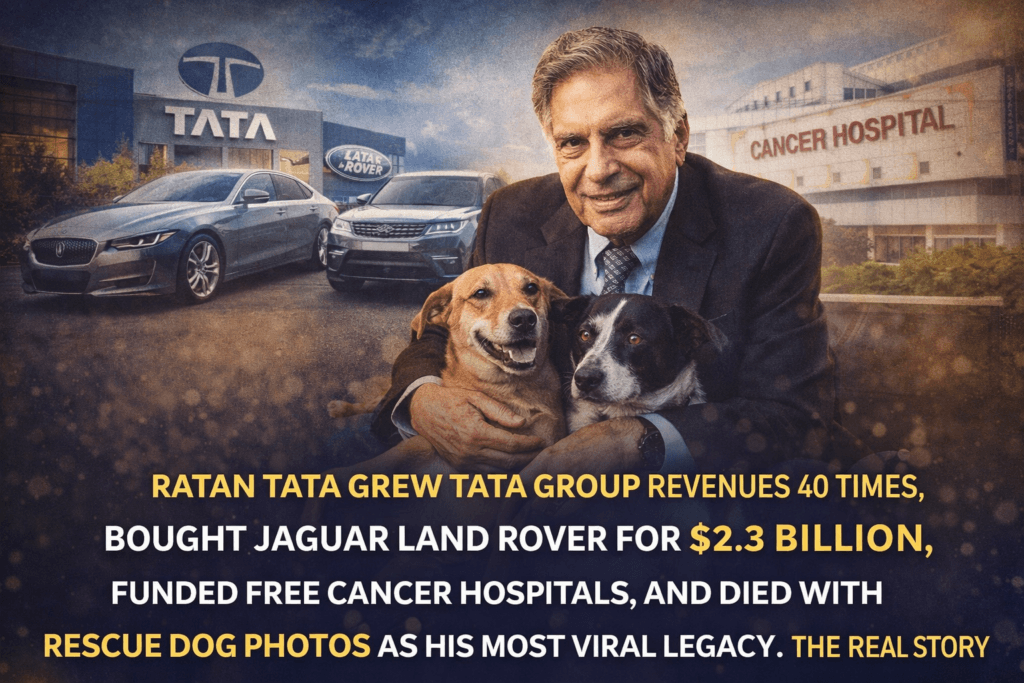
He was worth billions, controlled one of India’s oldest empires, and his most viral photographs were of him sitting on the floor playing with rescue dogs he’d adopted.
— The most quietly devastating commentary on what legacy actually looks like
The Childhood Nobody Talks About When They Talk About the Tata Name
Ratan Naval Tata was born on December 28, 1937, in Bombay, into the Tata family — which sounds like the most comfortable possible start. And in material terms, it was. But the family name came with a complicated personal life that the business mythology tends to smooth over.
When Ratan was ten years old, his parents separated. His father Naval Tata and his mother Soonoo parted ways, and Ratan was raised subsequently by his grandmother, Navajbai Tata — the widow of Sir Ratan Tata, the second son of Tata Group founder Jamsetji Tata. He grew up in a home shaped by a grandmother’s care rather than both parents. His younger brother Jimmy and, later, a half-brother Noel Tata from his father’s second marriage completed a family structure that was more complicated than the word “dynasty” usually implies.
He attended Campion School in Mumbai, then Cathedral and John Connon School, then Bishop Cotton School in Shimla, and finally Riverdale Country School in New York City — a transient, shifting educational path that took him across countries before he was eighteen. In 1955, he enrolled at Cornell University, studying architecture. And here the story takes a turn that the corporate biographies tend to skip past: he was lonely, homesick, and facing racial bias in 1950s America.
Cornell’s own documentary on his years there, created for his 50th reunion in 2009, captures it plainly. He was an Indian student in an America that had not yet processed what to do with people of colour. Letters home took weeks to arrive and provided only delayed comfort. He would queue for the single payphone in the fraternity building, calling late at night to account for the time difference. His father Naval would fly from Geneva after ILO meetings specifically to visit him — the visits were described as a lifeline for the barely-eighteen-year-old navigating a foreign culture that received him with suspicion.
He overcame it, as people do — by immersing himself in the fraternity, adapting to the culture, building friendships. He earned his Bachelor of Science in Architecture from Cornell in 1962 and subsequently worked at the architectural firm Jones & Emmons in Los Angeles before returning to India. He later completed the Harvard Business School Advanced Management Program in 1975.
The homesick teenager in a Cornell fraternity would go on to endow a $28 million scholarship fund at that same university, specifically so Indian students without financial means could attend. He gave back to the institution that had tested him most thoroughly. That is not a small thing.
Starting at the Bottom of His Own Family Company
Here is the fact about Ratan Tata’s entry into the Tata Group that most people know intellectually but don’t fully sit with: when he joined the company in 1962, he started on the shop floor of Tata Steel. Not in a corner office. Not in a strategic advisory role. On the floor of a steel plant, working alongside workers, learning the business from the bottom up.
This was not accidental. JRD Tata — his predecessor and the towering figure who ran Tata Group for decades — believed that no one could lead a business they hadn’t understood from the ground up. Ratan Tata absorbed that lesson completely. He spent years in various operational roles across different Tata subsidiaries before receiving any managerial authority. In 1971, he was made Director-in-Charge of NELCO (National Radio and Electronics Company) — a struggling subsidiary tasked to him specifically because it needed turning around, not because it was a prestige appointment.
He turned NELCO around. Then the 1970s economic slowdown hit and the company struggled again. He faced what any honest account of his career acknowledges: early managerial setbacks that did not resolve neatly. The 1975 appointment to the Harvard Advanced Management Programme was partly a reset — a chance to think more clearly about how large organisations actually work.
When JRD Tata stepped down in 1991 and named Ratan as his successor, the announcement surprised almost everyone. Senior executives — some of them enormously powerful figures within the group, like Russi Mody who ran Tata Steel and Ajit Kerkar who ran the Taj Hotels — had expected to succeed JRD. Ratan Tata was younger, less tested at the top level, and not who the old guard had expected. The resistance was immediate, institutional, and personal.
He handled it the way he handled most challenges throughout his life: quietly, systematically, and without visible drama. He implemented a retirement age across the group — which removed the most resistant figures from their entrenched positions. He required subsidiaries to report directly to the group office. He consolidated without announcing a consolidation. By the time people understood what had happened, it had already happened.
The Acquisitions That Changed What India Could Mean Globally
When Ratan Tata took over as chairman of Tata Sons in 1991, the company’s revenues were dominated by commodity sales — steel, chemicals, basic materials. When he stepped down in 2012, the majority of group revenues came from brands: Tetley Tea. Jaguar Land Rover. Corus Steel. TCS. The Taj Hotels globally. He oversaw a complete transformation in what Tata Group was and what it stood for.
The acquisitions deserve specific attention because they were each, at the time, considered either bold or reckless depending on who you asked:
- Tetley Tea (2000) — £271 million. This was the largest overseas acquisition by an Indian company at the time. Buying a British brand with British heritage using Indian capital was, in 2000, a statement that Indian business had arrived at a table it had previously only been invited to serve at.
- Corus Group (2007) — $12.1 billion. Tata Steel acquiring Corus — the Anglo-Dutch steel giant that was larger than Tata Steel itself at the time — for $12.1 billion was one of the most audacious deals in global M&A history. The Indian press was divided: some called it visionary, others called it overpriced. Corus ultimately proved difficult, was restructured into Tata Steel Europe, and the steel industry went through brutal cycles. But the acquisition established Tata as a company that could compete at the highest level globally.
- Jaguar Land Rover (2008) — $2.3 billion. Ford had paid $5.4 billion for Jaguar in 1989. By 2008, after years of losses, Ford needed to sell. Tata acquired both Jaguar and Land Rover for $2.3 billion — less than half of what Ford had paid for Jaguar alone nineteen years earlier. At the time, many analysts questioned whether an Indian company could manage British luxury car brands. By 2012, JLR was the most profitable part of the entire Tata Group, contributing the majority of group profits. It remains one of the most successful turnarounds in automotive history.
The JLR deal is the one that deserves the most sustained attention. When the acquisition was announced, the response in parts of the British press was barely disguised condescension — the idea that an Indian conglomerate would own Jaguar Land Rover struck some commentators as incongruous. By the time Ratan Tata retired in 2012, JLR had a record profit of £1.5 billion. The condescension had gone quiet.
The Nano: The Failure That Wasn’t What Everyone Said It Was
In 2009, Tata Motors launched the Tata Nano — marketed as the world’s cheapest car at approximately ₹1 lakh, designed to provide affordable personal transport to Indian families who couldn’t afford a standard car. The intent was genuinely social: give the vast Indian middle class access to safer transport than a motorcycle loaded with a family of four.
The Nano failed commercially. Sales were far below projections. The “cheapest car” positioning backfired — nobody wanted to be seen in the cheapest car. The product’s association with poverty undermined its appeal to exactly the aspiring middle class it was designed for. By 2018 the model was effectively discontinued.
Ratan Tata spoke about this failure with characteristic honesty. He said the mistake was in how the car was positioned and communicated — that calling it the cheapest car was the error, not the car itself. He called it a learning, not a regret. And then he moved on. He did not issue a long public defence. He did not quietly pretend it hadn’t happened. He acknowledged it and moved forward.
This is the specific kind of failure management that most business people claim to practise and almost nobody actually does. You either deny the failure, or you catastrophise it. Ratan Tata did neither. He named it, learned from it, and kept building.
Ratan Tata launched a product that failed publicly in front of all of India, said “that was a learning,” and went back to building JLR into the most profitable part of his empire. Most people can’t even post an Instagram story without deleting it if it gets less engagement than expected.
On what it actually looks like to do the thing before you’re certain it’ll work: Congratulations, You Googled “How to Be Motivated” Instead of Actually Doing the Thing
The Man Behind the Chairman
Ratan Tata never married. He spoke about this in interviews — not defensively, but openly — saying he had come close to marriage a few times, that circumstances and timing had not aligned, and that he had made peace with his solitude. He lived alone in his Mumbai home with his dogs: Tito and Tigor, rescue dogs he adopted and cared for with the same deliberateness he brought to everything else.
His public persona was one of the most consistent in Indian corporate history: soft-spoken, precise, self-effacing in the way that only genuinely confident people can manage. He never raised his voice in public. He was never caught in a tabloid controversy. He gave interviews rarely and said something real when he did. In a country where corporate excess was often a performance of power, Ratan Tata consistently performed the opposite — quiet authority that required no demonstration.
The philanthropic scale of his life was staggering and largely invisible until it was totalled up after his death. The Tata Trusts — which hold 66% of Tata Sons — fund cancer care hospitals, rural development, education, water access, and dozens of other initiatives across India. His personal estate at death was valued at approximately ₹10,000 crore, the majority of which was directed to charitable causes. In 2021, he launched Tata Medical Centre in Kolkata — a cancer care hospital where treatment was available for free to patients who couldn’t afford it.
He invested in over 40 startups in his personal capacity in his later years — Ola, Paytm, Snapdeal, Urban Ladder, Lenskart, Cure.fit — not primarily for returns but because he believed in the founders and in the businesses they were trying to build. Founders who received his backing described the calls with him the same way: he asked real questions, gave real feedback, and then left them to run their companies. He wasn’t performing mentorship. He was actually mentoring.
The Specific Kind of Legacy That Instagram Cannot Build
Here is what separates Ratan Tata’s legacy from almost everyone else on any list of India’s most powerful or wealthy people: the trust is personal, not institutional. People who had never met him trusted him. Workers at Tata companies in states he’d never visited felt connected to the values his name represented. When he died, the grief was not the grief of losing a celebrity — it was the grief of losing someone who had functioned as a kind of moral reference point in Indian public life.
This kind of trust cannot be manufactured. It cannot be purchased through PR campaigns or social media strategy. It is built slowly, over decades, through the alignment of what you say and what you actually do — through the decisions made when nobody is watching and no camera is present. The Tata Group’s policy of not paying bribes, maintained consistently across decades of Indian business history when the alternative would often have been easier and more profitable, is not a public relations document. It is a repeated choice made at the operational level over and over again, in the face of pressure and inconvenience, because the value was real rather than performative.
That’s what a legacy built without Instagram looks like. It looks like 66% of one of India’s largest conglomerates being held in trust for the public good. It looks like a cancer hospital where treatment is free. It looks like a $28 million scholarship fund at the university where you were once the lonely Indian student in a queue for the payphone.
It does not look like a million followers. It looks like a million people who never followed you but trusted you anyway.
What Ratan Tata’s Life Actually Teaches You
- Start at the bottom even if you own the building. Ratan Tata joined Tata Steel on the shop floor in 1962. He could have walked into any executive role his name entitled him to. He didn’t. He started where the understanding was deepest and the pretence was least. The respect that decision earned him inside the company lasted decades longer than any title would have.
- Quiet resistance to the expected path is its own form of courage. When JRD Tata named him successor, Ratan was the unexpected choice. Senior figures with more experience and longer tenure were passed over. He didn’t campaign for the job, didn’t grandstand his way to it. He was chosen for what JRD could see — and then he proved JRD right without ever making a performance of it.
- The failure that you acknowledge honestly builds more trust than the success you celebrate loudly. The Tata Nano failed. He said so, plainly. He named what went wrong. He didn’t spin it or minimise it or quietly let it be forgotten. The honesty built more credibility than any success story PR campaign could have.
- What you do with money after you’ve earned it is the actual measure. Ratan Tata spent his life building. He spent his death giving. The Tata Trusts, the Cornell scholarship, the Harvard endowment, the cancer hospital, the startup investments in founders he believed in — none of these needed to happen for him to be remembered as a great industrialist. He did them because he believed that wealth held in trust for people is more valuable than wealth held for yourself.
- The people who remember you most warmly are never the ones you tried to impress. The rescue dog photographs. The factory workers who said he remembered their names. The startup founders who said he gave real feedback instead of performed encouragement. These are not the testimonials of a man who spent his life managing appearances. They are the testimonials of a man who was consistently, quietly himself — and whose self turned out to be worth remembering.
The Final Word
Ratan Tata never flexed on Instagram. He never posted the acquisition announcement from a private jet. He never shared a net worth update or a Padma Vibhushan selfie or a motivational caption over a photograph of a view from somewhere expensive.
He bought Jaguar Land Rover and turned it into a ₹1.5 billion profit engine. He built a cancer hospital where treatment is free. He funded 40 startups and asked nothing in return except that the founders build something real. He sat on the floor with his dogs and smiled the smile of someone who didn’t need to prove anything to anyone.
He died at 86, and a country that had spent 86 years watching him said: we didn’t know how much we needed him until he was gone.
That is what a life spent building looks like, in contrast to a life spent performing.
The difference between the two is worth considering before you open the posting app.
More From SarcasticMotivators
Another builder who showed up when the crowd was against him and kept doing the work: Hardik Pandya: The Guy Who Got Booed at His Own Team’s Ground and Still Took Wickets
On performing in the small arenas before the big ones notice you: IPL 2026 Auction: ₹14 Crore for an Uncapped Player — Because Why Not
On 19 seasons of process over performance: MS Dhoni’s Retirement That Never Happens: A Love Story in Yellow
If you’re still waiting to feel ready before you start: Congratulations, You Googled “How to Be Motivated” Instead of Actually Doing the Thing
On direction over destination — the thirty-year approach: Your 5-Year Plan vs What Actually Happened: A Tragedy in Three Acts
On showing up for the Monday that could change things: Dear Monday: It’s Not You, It’s Me (Actually, It’s You)
The other outsider who arrived with nothing and built everything: Shah Rukh Khan Had No Godfather in Bollywood and Still Won — So What’s Your Excuse?
Frequently Asked Questions
When did Ratan Tata die and what was his legacy?
Ratan Naval Tata passed away on October 9, 2024, at Mumbai’s Breach Candy Hospital, aged 86. His legacy spans over two decades of transformational leadership at Tata Group — during which revenues grew 40 times and profits 50 times — and a lifetime of philanthropy that included founding cancer care hospitals, funding universities globally, and directing the majority of his personal estate to charitable causes. The Tata Trusts, which hold 66% of Tata Sons, fund healthcare, education, rural development and social initiatives across India. He received India’s Padma Bhushan (2000) and Padma Vibhushan (2008) — its third and second-highest civilian honours.
What did Ratan Tata study and where?
Ratan Tata graduated from Cornell University with a Bachelor of Science in Architecture in 1962, after attending Riverdale Country School in New York City for high school. He later completed the Harvard Business School Advanced Management Programme in 1975. He joined Tata Group in 1962 and started on the shop floor of Tata Steel — gaining operational experience across multiple Tata subsidiaries before assuming any managerial role. His architecture training at Cornell gave him a design sensibility and structural thinking that he credited with shaping how he approached complex business problems.
What were Ratan Tata’s biggest acquisitions?
During his chairmanship from 1991 to 2012, Ratan Tata oversaw three landmark international acquisitions. Tetley Tea was acquired in 2000 for £271 million — the largest overseas acquisition by an Indian company at that time. Corus Group, the Anglo-Dutch steel company, was acquired by Tata Steel in 2007 for $12.1 billion. Jaguar Land Rover was acquired from Ford in 2008 for $2.3 billion — less than half of what Ford had paid for Jaguar alone nineteen years earlier. JLR went on to become the most profitable division of the entire Tata Group by 2012, delivering record profits of £1.5 billion.
Why did the Tata Nano fail?
The Tata Nano was launched in 2009 as the world’s most affordable car at approximately ₹1 lakh, designed to give Indian families access to safe personal transport. It failed commercially for several reasons. The “cheapest car” positioning backfired: the aspiring Indian middle class — the car’s intended audience — did not want to be associated with a product marketed as the cheapest available. The car also faced early negative publicity around fires in a few units, which damaged consumer confidence. Ratan Tata acknowledged the failure honestly, saying the mistake was in the positioning and communication, not in the product’s intent. The Nano was discontinued by 2018.
Did Ratan Tata ever marry?
No. Ratan Tata never married. He spoke openly about this in interviews, acknowledging that he had come close to marriage on a few occasions but that circumstances, timing, and the demands of his career had not aligned with a lasting partnership. He lived alone and was known for his deep affection for animals — particularly his rescue dogs Tito and Tigor, whom he adopted and cared for in his later years. Photographs of him sitting on the floor playing with his dogs became among the most shared images after his death in October 2024.
How much did Ratan Tata donate to Cornell University?
Ratan Tata donated $50 million to Cornell University in 2008, becoming the largest international donor in the university’s history at that time. The Tata Education and Development Trust established a $28 million Tata Scholarship Fund at Cornell, specifically designed to provide financial aid to undergraduate students from India regardless of their financial circumstances — ensuring the best Indian students could access Cornell without financial barriers. The gift was personal for Tata: he had studied at Cornell as a homesick eighteen-year-old in the mid-1950s, facing racial bias and struggling to adjust, and he returned to the institution decades later as its most generous international benefactor.