
Every year, somewhere around November, the same conversation starts. A former cricketer says something on a panel show. An “insider source” talks to a journalist. Fans start trending something on X. And the question that has been asked every single season since 2020 rises again like it’s never been answered before: Is this MS Dhoni’s last IPL?
Here we are in March 2026. IPL starts on March 28. Dhoni is 44 years old. He has a knee that gives him trouble. He retired from international cricket six years ago. CSK finished last in both 2024 and 2025. They’ve signed Sanju Samson — a wicketkeeper — which means even Dhoni’s position behind the stumps is no longer guaranteed. Robin Uthappa has gone on JioHotstar and said, with the calm certainty of someone who has said the same thing before, that “IPL 2026 is likely to be his last year in the yellow jersey.”
And Dhoni? When asked at the CSK ROAR’26 event whether he’d play till he’s 60, he looked at the crowd, smiled the smile of a man who has outlasted every prediction made about him, and said: “I can try.”
Two words. Crowd goes insane. Retirement conversation postponed indefinitely. See you again in November.
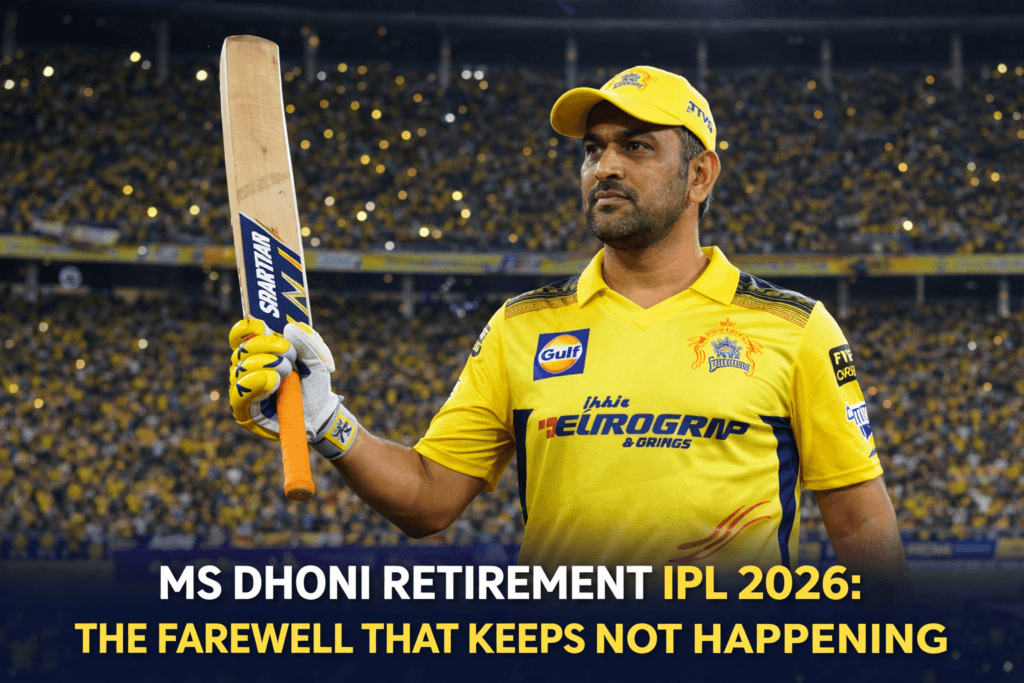
MS Dhoni has been “retiring” for five years. He has more farewell seasons than some players have actual seasons.
— Said with love, because that’s exactly what makes him Dhoni
The Numbers First — Because They’re Absurd
Before we get sentimental, let’s just look at what MS Dhoni has actually done in the IPL, because the numbers have a habit of making everyone shut up and listen.
Dhoni has played 278 IPL matches — more than any other player in the history of the tournament. He has scored 5,439 runs across those matches. He captained CSK to five IPL titles: 2010, 2011, 2018, 2021, and 2023 — making him the joint-most successful captain in IPL history alongside Rohit Sharma. He is the first wicketkeeper in IPL history to complete 200 dismissals. And he did all of this while also winning a T20 World Cup (2007), an ODI World Cup (2011), a Champions Trophy (2013), and becoming widely considered the greatest limited-overs captain in the history of Indian cricket.
If this is IPL 2026, it will be his 19th season. The IPL is literally 19 years old. MS Dhoni has been there for every single one of them. That’s not a career. That’s an institution.
How We Got Here: The Man from Ranchi Who Nobody Expected
Mahendra Singh Dhoni was born on July 7, 1981 in Ranchi, Jharkhand — a city that, at the time, was part of Bihar and had produced no notable international cricketers. His father Pan Singh worked in junior management positions at MECON, a government enterprise. The family was lower-middle class. Dhoni’s early cricket wasn’t even on a proper ground — he played in whatever space was available, with whatever equipment could be arranged.
He played as a goalkeeper for his school football team — which is where, his coaches later noted, he first developed the lightning-fast reflexes behind the stumps that would make him famous. His cricket talent was spotted by a coach named Keshav Banerjee who saw him keeping wickets in a local match and recommended him to the Commando Cricket Club. Dhoni started taking cricket seriously at 15.
What happened next is the part that most people know but rarely sit with long enough. Dhoni played domestic cricket for Bihar and then Jharkhand for years — years in which he was good enough to be noticed but not quite breaking through to the national team. He took a job as a Travelling Ticket Examiner with the South Eastern Railway to support himself while continuing to play. The TTE job paid ₹5,500 a month. He was doing night shifts and catching trains to cricket matches on his days off.
India A called him up. Then India called him up for the 2004 Bangladesh tour. He made just 0 runs — run out for a duck on debut. The selectors kept faith. The next tour, against Pakistan in 2005, he scored 148 runs. By the end of 2005, he had the highest ODI score by an Indian wicketkeeper — 183 not out against Sri Lanka. From railway ticket examiner to record-breaking ODI batter in under two years.
The Retirement Timeline — A Comedy of Predictions
Here is a brief, incomplete history of all the times MS Dhoni was supposed to retire and didn’t:
- 2019: India lost the World Cup semi-final to New Zealand. Dhoni was run out. Pundits declared his international career over. They were right but for the wrong reasons — he didn’t make the announcement immediately, leaving the nation in a months-long suspension of uncertainty.
- August 2020: Retired from international cricket via a quiet Instagram post on Independence Day. No press conference. No farewell match. Just a video and a caption. Exactly Dhoni.
- IPL 2020: First IPL after international retirement. Immediately declared his IPL career would also end soon. CSK finished last. “This was probably his last season,” said everyone.
- IPL 2021: CSK won the title. Dhoni lifted the trophy. Nobody talked about retirement for six months.
- IPL 2022: Handed over captaincy to Ravindra Jadeja mid-season. Then took it back when Jadeja resigned. “Definitely his last season,” said everyone.
- IPL 2023: Won the title again. At 41. Dhoni smiling. Everyone crying. “Okay THIS is his farewell,” said everyone.
- IPL 2024: CSK finished last. Knee surgery rumours. “He can’t continue,” said everyone.
- IPL 2025: CSK finished last again. Scored 196 runs in 13 innings. Became the first keeper with 200 IPL dismissals. “Surely THIS is his last season,” said everyone.
- IPL 2026: “I can try,” said Dhoni.
What IPL 2026 Actually Looks Like for Dhoni
The honest picture of Dhoni’s role in IPL 2026 is different from the mythology. He won’t be batting at number seven anymore — Robin Uthappa’s prediction that he’ll bat at number eight is probably close to right. CSK have signed Sanju Samson, who is a wicketkeeper himself, meaning Dhoni’s gloves-and-stumps role could shift entirely to mentorship.
The knee has been a genuine issue. He had a procedure on it and his movement behind the stumps has visibly slowed over the last two seasons. He still takes blinders — the muscle memory of 25 years of keeping wickets doesn’t disappear — but the footwork isn’t what it was in 2011.
CSK CEO Kasi Viswanathan has confirmed he will play: “He will play, he will play.” The question isn’t whether Dhoni plays IPL 2026 — he is. The question is what his role looks like in a squad that now has Ruturaj Gaikwad as captain, Sanju Samson as wicketkeeper-batter, and a group of young players like Ayush Mhatre, Prashant Veer, and Kartik Sharma who need development more than they need Dhoni’s bat at number seven.
His role in 2026 is probably this: keep wickets when possible, bat when the situation demands it, provide calm in the dressing room during crisis moments, and be the largest presence in the stadium simply by walking onto the field. The Chepauk crowd chanted his name at the ROAR’26 event before he’d said a single word. His presence alone changes how a team feels — and how the opposition feels. That is not nothing. That is actually a very specific thing that CSK have decided is worth a spot in their eleven.
The Part That Nobody Talks About When They Talk About Dhoni
Everybody talks about the helicopter shot. The 2011 World Cup six. The calm. The composure. The results. What people talk about less is the consistency of process that produced all of that.
Dhoni’s preparation routines are legendary among people who’ve worked with him. He arrives early. He stays late. He asks questions about opposition bowlers with the same seriousness at 44 as he did at 24. Former CSK players have said in interviews that Dhoni’s practice sessions — his net sessions, his keeping drills, the way he studies a match situation — are indistinguishable in their intensity from when he was at his physical peak. The body has aged. The approach hasn’t.
This is the thing that the “retirement or not” debate completely misses. The question everyone is asking is whether Dhoni can still perform at the level he used to. The more interesting question is: what does it say about the man that he has maintained the standards of preparation for 19 consecutive seasons while everyone around him kept predicting he was done?
The sarcastic motivation in Dhoni’s story isn’t “keep going despite what people say.” It’s more specific than that: he has never — not once — let the noise about his future change how seriously he takes his present.
Every year someone asks if this is his last season. Every year he shows up to nets, studies the conditions, and plays his game. That gap — between what is being said about you and what you are doing about yourself — is the entire lesson.
What Happens When He Actually Does Retire
Here’s the strange thing about Dhoni’s eventual retirement — whenever it happens. It won’t feel real at first. We’ve been told it was coming for so long that the actual announcement, when it comes, will probably produce a collective “wait, actually?” before the grief sets in.
The CSK he leaves behind is a franchise built on his personality as much as his cricket. The yellow jersey’s emotional weight comes largely from what he has done inside it. Ruturaj Gaikwad is a genuinely talented captain who will develop his own identity — Robin Uthappa is right that he needs space to do that without Dhoni’s shadow. But the transition from “CSK with Dhoni” to “CSK without Dhoni” is a cultural shift, not just a squad change. It will take a few seasons for the franchise to feel fully itself without him.
What Dhoni himself does after cricket is probably the most interesting question. He’s a licensed pilot. He runs a fitness app. He has a farm in Ranchi where he apparently genuinely prefers to spend time over everything else. He has said in interviews that he finds cities overwhelming and that the farm, the cows, and the quiet are what he actually looks forward to. The man who orchestrated some of the most pressure-filled finishes in cricket history is happiest when there is absolutely nothing happening.
That checks out, actually.
5 Things Dhoni’s Career Actually Teaches You
- Where you start is not the ceiling. Railway TTE from Ranchi to five-time IPL champion and World Cup-winning captain. The distance between those two points is so large it should make every “I don’t have the right background” excuse feel embarrassing.
- Process over noise. For 19 seasons, people have predicted, debated, and declared the end of Dhoni’s career. His response has been to show up to practice on time every day. Process over noise isn’t a poster quote for Dhoni — it’s his actual operational method.
- The calm is a skill, not a personality trait. Dhoni did not come out of the womb unflappable. He trained himself to manage pressure. The stories from his Jharkhand days describe a young player who was not always composed. The calm that people call “natural” was built deliberately over years of high-stakes situations.
- Know when to evolve your role. He gave up the captaincy when it was the right thing for CSK. He moved down the batting order when the team needed it. He let Sanju Samson take the keeping gloves when that was what the squad required. The ego that insists on holding yesterday’s role is the enemy of a long career.
- Outlast the narrative. Every narrative about Dhoni has been wrong — about his age, his fitness, his relevance, his future. He is still here. The narrative is not. Show up long enough and the story writes itself.
The Honest Verdict on IPL 2026
Is IPL 2026 really MS Dhoni’s last season? Probably. The knee, the age, the squad rebuild, the emergence of Sanju Samson as CSK’s keeper — all of it points to a natural endpoint. Robin Uthappa says so. Irfan Pathan says so. Most people who follow CSK closely say so.
But they’ve said so before. Every year for five years.
And every year, Dhoni has walked out at Chepauk, the crowd has lost its collective mind, and the man has kept wickets and hit a couple of boundaries and looked like someone who has absolutely no interest in going anywhere.
IPL 2026 starts March 28. Dhoni will walk out. The crowd will roar. The retirement question will be temporarily forgotten. And sometime around October, when the season ends, we will all hold our breath and wait for the Instagram post.
Or he’ll just say “I can try” again, and we’ll do the whole thing over in 2027.
With Dhoni, honestly? Either is possible.
Also Read From SarcasticMotivators
Dhoni’s CSK bought two uncapped players for ₹14.20 crore each at the IPL 2026 auction. Both of them started from obscure state leagues with ₹30 lakh base prices. If you liked this, you’ll want to read: IPL 2026 Auction: ₹14 Crore for an Uncapped Player — Because Why Not
And if you want the other side of the “performing when the crowd turns on you” story — the player who got booed at his own team’s ground and still took wickets: Hardik Pandya: The Guy Who Got Booed at His Own Team’s Ground and Still Took Wickets
Frequently Asked Questions
Will MS Dhoni play IPL 2026?
Yes. CSK CEO Kasi Viswanathan confirmed in an interview that Dhoni will play IPL 2026, saying simply: “He will play, he will play.” Dhoni himself appeared at the CSK ROAR’26 squad unveiling event in March 2026 and responded to a fan’s question about playing till 60 with his now-famous two-word answer: “I can try.” IPL 2026 begins on March 28.
Is IPL 2026 MS Dhoni’s last season?
Most cricket analysts and former players believe IPL 2026 will be Dhoni’s final season. Robin Uthappa stated on JioHotstar that “IPL 2026 is likely to be his last year in the yellow jersey,” predicting Dhoni will take a mentor-cum-player role batting at number eight. Irfan Pathan has made similar predictions. However, Dhoni himself has not confirmed any retirement plans, and he has repeatedly surprised observers by continuing to play beyond every predicted endpoint.
How many IPL titles has MS Dhoni won?
MS Dhoni has won five IPL titles as captain of Chennai Super Kings: in 2010, 2011, 2018, 2021, and 2023. This makes him the joint-most successful captain in IPL history alongside Rohit Sharma, who also won five titles with Mumbai Indians. Dhoni has played 278 IPL matches in total — more than any other player — and scored 5,439 runs across those appearances.
What is MS Dhoni’s role in CSK IPL 2026?
In IPL 2026, Dhoni is expected to play a reduced but still significant role. Ruturaj Gaikwad remains CSK’s captain. With Sanju Samson — himself a wicketkeeper — joining CSK ahead of IPL 2026, Dhoni’s keeping duties may be limited or shared. He is expected to bat lower in the order (number eight according to Uthappa), focus on mentoring younger players like Ayush Mhatre, Prashant Veer, and Kartik Sharma, and continue providing the on-field calm that CSK teams have relied on for nearly two decades.
Where is MS Dhoni from and what was his early life like?
MS Dhoni was born on July 7, 1981 in Ranchi, Jharkhand (then part of Bihar). His father Pan Singh worked in management positions at MECON, a government enterprise. The family was lower-middle class. Dhoni played football as a goalkeeper in school before being introduced to cricket at 15 by coach Keshav Banerjee. After years in domestic cricket for Bihar and Jharkhand, he took a job as a Travelling Ticket Examiner with South Eastern Railway earning ₹5,500 per month while continuing to play cricket. He made his international debut in 2004 and scored a record ODI century for a wicketkeeper against Sri Lanka in 2005.
How many IPL matches has MS Dhoni played?
MS Dhoni has played 278 IPL matches — the most of any player in IPL history. He has scored 5,439 runs across those matches and become the first wicketkeeper in IPL history to complete 200 dismissals. He has been with Chennai Super Kings since the very first IPL season in 2008, and IPL 2026 will be his 19th season in the tournament.