
There are exactly three careers in the Indian parent universe. Doctor. Engineer. Government job. The order of preference varies slightly depending on whether your family is from the north, south, east, or west, and whether your parents have a cousin who is a doctor earning well or a cousin who is an engineer working night shifts for a US company in a city far from home. But the trinity is constant. It has been constant for thirty years. It will, if nothing changes, be constant for thirty more.
The only problem is that the world in which those three careers represented the entirety of the viable options no longer exists. The economy has moved. The skills market has shifted. The salary data for 2026 tells a story that the aunty at the family gathering has not been briefed on, and that briefing is long overdue.
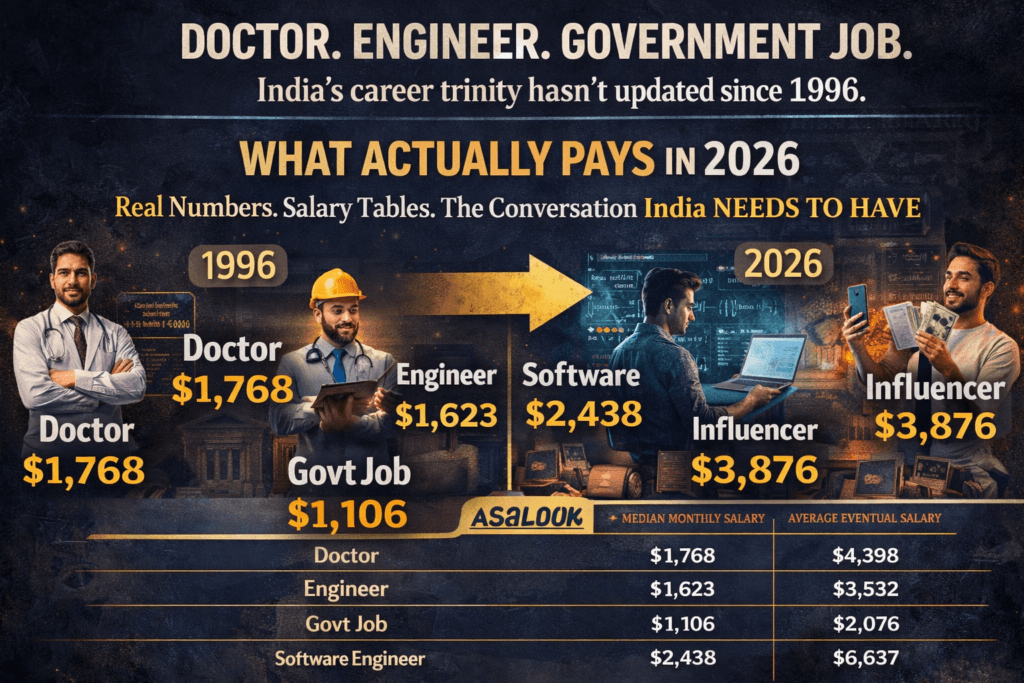
This is not an article telling you to abandon your parents’ values or disrespect their experience. Their advice came from a genuine place — from a generation that watched education lift families out of poverty, that saw government jobs provide security when private sector work was unstable, that understood medicine and engineering as the clearest paths from a small town to a middle-class life in a big city. That advice was correct for its time.
The time has changed. The advice has not. Let’s look at what’s actually happening.
“Beta, doctor bano, engineer bano, sarkari naukri lo.” Meanwhile, the highest-paid fresher in your colony just got ₹28 LPA at a startup and has never owned a stethoscope.
— Every Indian family dinner, 2026 edition
The Parent Advice Playbook — Translated Honestly
Before the salary data, let’s be fair to the advice itself. Here is what Indian parents have been saying for three decades, and what they actually mean when they say it:
“Become a doctor.” What they mean: choose a profession with social respect, a clear path from qualification to income, work that cannot be automated or outsourced, and the kind of status that makes the neighbour’s mother quiet at social events.
“Become an engineer.” What they mean: get a technical degree that opens doors, learn skills that are transferable across industries, have something concrete on your resume that parents can explain to relatives without a ten-minute context-setting conversation.
“Get a government job.” What they mean: have security. Pension. Stability. A life where a market crash, a startup closure, or a global pandemic does not immediately threaten your ability to pay the rent. After watching 1991, 2008, and 2020 play out, the desire for a job that cannot be taken away by a PowerPoint presentation titled “restructuring” is not irrational.
None of this advice is wrong in its underlying logic. The problem is the specific professions prescribed, not the values underneath them. The values — security, respect, transferable skills, social contribution — are as valid in 2026 as they were in 1996. The specific careers that those values led previous generations to choose are no longer the only — or even the best — way to achieve them.
What the 2026 Salary Data Actually Says
Let’s look at real numbers. Not projections. Not aspirational figures from course-selling websites. What the verified salary data from NASSCOM, Naukri, TalentSprint, and Taggd says about what India’s job market actually pays in 2026.
The Careers Parents Recommend
| Career | Entry-Level Salary | Mid-Career (5–10 yrs) | Senior / Specialist |
|---|---|---|---|
| MBBS Doctor (Private) | ₹4–10 LPA | ₹10–20 LPA | ₹20–40 LPA (specialist) |
| MBBS Doctor (Govt.) | ₹70K–1.2L/month (stable) | Incremental | ₹1.5–2.5L/month |
| B.Tech Engineer (general) | ₹3.5–7 LPA | ₹8–15 LPA | ₹15–25 LPA |
| IIT Engineer | ₹12–20 LPA | ₹20–40 LPA | ₹40–80 LPA+ |
| Government Job (IAS/IPS) | ₹56K/month + allowances | ₹70K–1.2L/month | ₹1.5–2.5L/month + perks |
| Bank PO / Clerk | ₹4–7 LPA | ₹8–14 LPA | ₹14–20 LPA |
The Careers Parents Don’t Know About Yet
| Career | Entry-Level Salary | Mid-Career (3–5 yrs) | Senior / Lead |
|---|---|---|---|
| AI / ML Engineer | ₹18–28 LPA | ₹28–45 LPA | ₹45–80 LPA+ |
| Generative AI / LLM Engineer | ₹20–35 LPA | ₹35–60 LPA | ₹60–1 Cr+ |
| Cloud Architect | ₹15–25 LPA | ₹25–45 LPA | ₹40–70 LPA |
| Cybersecurity Specialist | ₹8–18 LPA | ₹18–35 LPA | ₹35–60 LPA |
| Full Stack Developer | ₹5–12 LPA | ₹12–25 LPA | ₹25–45 LPA |
| Data Scientist | ₹9–18 LPA | ₹18–35 LPA | ₹35–60 LPA |
| Product Manager (tech) | ₹12–22 LPA | ₹22–45 LPA | ₹45–90 LPA |
| Investment Banker (IB) | ₹12–25 LPA | ₹25–55 LPA | ₹55–1.2 Cr+ |
| Content Creator / YouTuber | Unpredictable | ₹20–60 LPA (top tier) | ₹1 Cr+ (established) |
| UI/UX Designer | ₹4–9 LPA | ₹9–22 LPA | ₹22–40 LPA |
The numbers in the second table are not from a dream. They are from NASSCOM, Naukri.com’s salary reports, TalentSprint’s 2026 analysis, and the India Skills Report. A fresher AI engineer at TCS or Infosys in Bangalore in 2026 is landing ₹18–28 LPA. A Generative AI specialist with LLM expertise is starting at ₹20–35 LPA. These are not exceptional salaries for exceptional people — they are entry-level salaries for people with the right skills who graduated last year.
Compare that to a fresh MBBS graduate entering private practice at ₹4–10 LPA — after five and a half years of MBBS, a mandatory internship, and in many cases additional years of MD or MS specialisation. The doctor earns more eventually. But the gap in time-to-income and the cumulative cost of the education (including coaching for entrance exams) means the financial case for medicine as a wealth-building career is far weaker than it was twenty years ago.
The Government Job Argument — And Why It’s More Complicated Than Either Side Admits
Here is where the sarcasm has to pause for a moment, because the government job argument deserves honest treatment rather than easy dismissal.
Your parents are not wrong about security. The 2020 COVID lockdown, in which lakhs of private sector workers lost their jobs overnight while government employees continued to receive salaries with no disruption, was a real-world experiment in job security that proved their point clearly. A Bank PO who earns ₹7 LPA but has a pension, medical benefits, housing allowance, and near-zero layoff risk is not obviously worse off than a startup employee earning ₹18 LPA with no benefits and a Sword of Damocles over their head every funding cycle.
The honest conversation about government jobs is not “they pay badly” — some of them pay reasonably well, especially at senior levels, and the non-salary benefits package is genuinely significant. The honest conversation is about whether the specific version of security a government job provides is the security you personally need, versus the kind of upside a private-sector career in a high-growth field can provide over the same time horizon.
An IAS officer who clears the UPSC at 24 and retires at 60 will have had a genuinely important, high-impact career with substantial real-world authority. A peer who entered AI engineering at 22 and is a principal AI architect at 35 will have a higher net worth, less social authority, and significantly more professional volatility. Whether the first or second trajectory is better depends entirely on what you actually want from a working life — not on which one your relatives consider more prestigious.
The Three Careers Nobody Told You About — That Are Real and Paying Well Right Now
1. Generative AI & LLM Engineering — The Single Highest-Paying Fresher Path in 2026
Large Language Model engineering — working with models like GPT, Claude, and Gemini to build products and deploy AI systems — is the highest-paid technical specialisation in India in 2026. Full stop. Senior LLM engineers with agentic AI experience (frameworks like LangChain, CrewAI, AutoGPT) are commanding packages that start at ₹60 LPA and go well past ₹1 crore for the best talent.
The entry point is not as far as most people assume. A fresher with Python, machine learning fundamentals, and a demonstrable project involving LLMs — a chatbot, a RAG system, a fine-tuned model — is getting offers between ₹20–35 LPA from startups and ₹18–28 LPA from large tech companies. The skill is new enough that there are very few experienced practitioners, which means the people who learn it now face almost no competition from people with more years of experience — because almost nobody has more years of experience in a field that barely existed three years ago.
This is what “early” looks like in a career context. The people who learn AI engineering in 2026 are in the same position CarryMinati was on YouTube in 2009 — the ecosystem is just forming, and the people who are in it before the crowd are the ones who will define the standards everyone else has to meet. Being early to something that turns out to be real is the most durable career advantage that exists.
2. The Creator Economy — India’s Most Misunderstood Career Path
India’s creator economy is valued at over $2 billion and growing. YouTube, Instagram Reels, and podcast platforms are paying creators at a scale that was unimaginable five years ago. This is not a supplementary income stream for people with other jobs. It is a primary income source for a growing number of Indians who understood earlier than most that an audience of their own is more valuable than a salary from someone else’s company.
The top tier of Indian creators earns well over ₹1 crore annually — from a combination of ad revenue, brand deals, sponsorships, merchandise, and platform-specific monetisation tools. The mid tier — creators with 1–5 million engaged followers in a specific niche — earns ₹20–60 LPA. This is not exceptional. This is what the salary range looks like for people who started consistently posting three to five years ago and kept going.
The catch is that this path requires something the other careers don’t — you have to start before it’s financially viable and keep going long enough for it to become so. That gap, between starting and earning, is where most people stop. The people who don’t stop are the ones who end up with the numbers above. The starting is the hardest part, not the sustaining.
3. Product Management — The Career That Combines Everything
A product manager at a funded tech startup in 2026 earns ₹12–22 LPA at entry level and ₹45–90 LPA within five years. Senior VPs of Product at mid-sized unicorns are touching ₹90–1.2 crore annually. The role combines technical understanding (you don’t need to code, but you need to understand what code can and cannot do), business thinking, user empathy, and communication — it is the career that rewards people who are good at multiple things rather than exceptional at one specific thing.
The route to PM is diverse: engineers who develop people skills, MBAs who develop product intuition, designers who develop business sense. There is no single degree that produces product managers — which means the field has lower artificial barriers to entry than medicine or law, but higher real barriers in the form of demonstrated judgment and cross-functional thinking.
Product management is the career your parents would love if they understood what it was. It’s stable (product companies don’t disappear the way startups do), well-paid, and increasingly in demand as every company in every sector builds digital products. The problem is that “product manager” does not translate neatly into a single-sentence answer to “beta kya karte ho?” — which is, in the Indian parent ecosystem, a significant obstacle to full acceptance.
The Honest Conversation Nobody Has at the Dining Table
Here is the thing about Indian parent career advice that the sarcasm needs to make room for: the advice comes from love and from fear. The love is real. The fear is also real — based on lived experience of what happens to families when income is unstable, when the professional credentials don’t hold up, when the glamorous-sounding career turns out to be glamorous only from the outside.
The advice is not malicious. It is outdated. And outdated advice, given with genuine care, still produces worse outcomes than no advice at all if the person receiving it cannot tell the difference between the love behind the advice and the accuracy of the advice itself.
The most useful conversation to have — both with your parents and with yourself — is not “your advice is wrong.” It’s “what outcome are you actually trying to achieve, and which path in 2026 most reliably produces that outcome?”
If the outcome is security: AI engineering offers higher salaries with reasonable job security at established companies, government jobs offer lower salaries with near-total job security. Both are legitimate choices. Choose based on your actual risk tolerance, not your parents’ risk tolerance.
If the outcome is social respect: this one is harder to fix with salary data, because social respect in India is still heavily attached to specific credentials. The engineer and the doctor get respect immediately. The AI engineer gets a blank look and then “oh, computer wala?” The product manager gets “so you manage a product? Like, in a warehouse?” The creator economy gets “YouTube? Serious karo beta.” This is a real cost and it’s worth acknowledging — not as a reason not to pursue these careers, but as a real thing you’ll have to navigate.
If the outcome is wealth-building over the long term: the data is unambiguous. AI engineering, product management, and the creator economy all offer faster wealth accumulation than most traditional Indian career paths, with the exception of the top tier of medicine (specialists in metros) and the top tier of government (IAS with post-retirement opportunities). The traditional paths are not dead. They are just no longer the fastest routes to the outcomes they were once the only routes to.
Shah Rukh Khan’s family told him to get a real job. Ratan Tata’s family expected him to run the empire. CarryMinati’s parents watched their son skip his board exams to make YouTube videos. All three ended up building something that paid better than most conventional careers. The common thread: they chose their own path and executed it with full commitment rather than half-commitment to someone else’s plan.
On the outsider who built Bollywood’s biggest empire: Shah Rukh Khan Had No Godfather in Bollywood and Still Won
On the quietest empire builder: Ratan Tata Never Flexed on Instagram. He Just Built an Empire. Noted.
On the boy from Faridabad who skipped his board exams and has 45 million subscribers: CarryMinati Started YouTube at 10 and Built a ₹40 Crore Brand
The Tier-2 and Tier-3 City Angle — Because Not Everyone Is in Bangalore
One thing the career data discussions almost always miss is that the salary numbers above are largely metro-centric. The ₹18–28 LPA AI fresher package is from Bangalore, Hyderabad, and Delhi NCR. Tier-2 and Tier-3 cities tell a different story — both in terms of what’s available and in terms of what those salaries actually buy you.
But here’s the counterpoint that matters for 2026 specifically: remote work has changed this calculation significantly. An AI engineer in Lucknow earning ₹22 LPA for a Bangalore or US-headquartered company — working from home — is in a dramatically better financial position than the same person would have been in 2019. Taggd’s 2026 hiring data shows a 25–35% increase in hiring from tier-2 and tier-3 cities. The companies are hiring remotely, the salaries are metro-scale, and the cost of living is tier-2.
This is new. This is very new. And it is specifically relevant to the Indian parent career advice framework — because a big part of the traditional career advice was shaped by the assumption that the best careers required migration to a metro. That assumption is crumbling in real time. The AI engineer from Patna working remotely for a Hyderabad startup at ₹20 LPA, living at home, with no rent to pay, is arguably in a better financial position than the same person at ₹25 LPA paying ₹30,000 per month for a flat in Koramangala.
A Letter to Both Sides of the Dining Table
To the parents: Your advice came from a genuine place. You watched education change the trajectory of families. You watched government jobs provide stability through economic shocks. You watched medicine and engineering translate into social mobility in ways that earlier generations had no access to. That was real. The world you built that advice from was real. What has also changed is real — and the children you raised in that world now have to operate in the 2026 version of it, not the 1996 version. The kindest thing you can do is update your map of the territory, even if it means learning what an AI engineer actually does, or why a YouTube channel can be a real business, or why your child’s product management job pays more than your brother-in-law’s senior engineering role.
To the children: Your parents’ advice is outdated in its specifics, but not wrong in its values. Security is still worth wanting. Transferable skills are still worth building. Social contribution is still worth caring about. The question is which careers in 2026 best deliver those values — and the answer is now much broader than it was when your parents were making their choices. The burden is on you to research that question honestly, make your own choice with full information, and then execute that choice with the kind of commitment that doesn’t allow the career to become a comfortable excuse for not working hard.
The career advice war across the dining table resolves not through who wins the argument, but through who does the work. Googling your career options instead of building the skills for them is the same problem dressed in different clothes.
The Bottom Line — As a Table, Since Indians Trust Data More Than Opinions
| What Parents Recommend | What 2026 Data Says | Verdict |
|---|---|---|
| MBBS → Doctor | Strong long-term, slow start. 5.5+ years + PG for full potential. High social capital. | Valid. But not the fastest route to financial stability. |
| B.Tech Engineering | Depends entirely on specialisation. General engineer: moderate. AI/ML engineer: exceptional. | Partially valid. The degree matters less than the specialisation within it. |
| Government Job (UPSC/Bank PO) | Best job security in India. Salary caps but non-salary benefits significant. Remote work irrelevant. | Valid if security is your primary value. Poor choice if wealth-building is. |
| CA / MBA | CA: ₹7–15 LPA entry, ₹20–50 LPA senior. MBA (IIM): ₹20–40 LPA entry. Investment banking: ₹40–1.2 Cr. | Valid, especially IIM MBA and Big 4 CA. High competition and cost of preparation. |
| Nobody recommended: AI Engineering | ₹18–40 LPA entry. ₹60–1 Cr+ senior. 22–25% demand growth. Fastest growing salary band in India. | The best career parents haven’t heard of yet. |
| Nobody recommended: Creator Economy | Unpredictable start. ₹20–60 LPA mid-tier. ₹1 Cr+ top tier. India creator economy $2B+ and growing. | Highest upside, highest variance. Not for the risk-averse. |
The Final Word
The Indian parent career advice is not your enemy. The gap between the advice and the 2026 reality is the problem — and closing that gap requires both sides to have an honest conversation that most Indian families are not having yet.
Your parents want you to be secure. They want you to be respected. They want your choices to produce a life that is less difficult than theirs. Those are not wrong things to want for you. The specific careers they’ve chosen as the vehicles for those outcomes — the doctor, the engineer, the government officer — were right for their generation and remain viable but are no longer the only paths, or even the fastest paths, to the outcomes they actually care about.
The fastest paths in 2026 run through AI, through building an audience, through products and platforms that didn’t exist ten years ago. The map has changed. The destination hasn’t.
Update the map. Have the conversation. And then — whether you choose the path your parents recommend or a path they haven’t heard of yet — execute it with complete seriousness.
Because the only career that definitely doesn’t pay well is the one you’re “planning” to start.
More From SarcasticMotivators
The man who showed up even when the crowd turned against him — and what that teaches you about career resilience: Hardik Pandya: The Guy Who Got Booed at His Own Team’s Ground and Still Took Wickets
On performing well in the small arenas before anyone notices: IPL 2026 Auction: ₹14 Crore for an Uncapped Player — Because Why Not
The season-by-season approach that beat every five-year plan: MS Dhoni’s Retirement That Never Happens: A Love Story in Yellow
The reason you haven’t started the career pivot yet: Congratulations, You Googled “How to Be Motivated” Instead of Actually Doing the Thing
Why your five-year career plan probably doesn’t match what’s happening: Your 5-Year Plan vs What Actually Happened: A Tragedy in Three Acts
On Monday mornings when the career choice doesn’t feel right: Dear Monday: It’s Not You, It’s Me (Actually, It’s You)
The Delhi boy who had no connections and built Bollywood’s biggest brand: Shah Rukh Khan Had No Godfather in Bollywood and Still Won
The man who built ₹12,490 crore without a single Instagram post: Ratan Tata Never Flexed on Instagram. He Just Built an Empire. Noted.
The kid from Faridabad who skipped his boards and has 45 million subscribers: CarryMinati Started YouTube at 10 and Built a ₹40 Crore Brand
Frequently Asked Questions
What are the highest paying jobs in India in 2026?
According to NASSCOM, TalentSprint, and Naukri salary reports, the highest-paying jobs in India in 2026 are concentrated in AI and technology. AI and ML Engineers earn ₹18–40 LPA at entry to mid-career levels, with senior roles at ₹40–80 LPA or more. Generative AI and LLM Engineers represent the single highest-paid fresher category, starting at ₹20–35 LPA with experienced professionals earning over ₹1 crore. Investment Bankers at top firms can earn ₹40–1.2 crore at senior levels. Product Managers at tech companies earn ₹12–22 LPA at entry with senior roles at ₹45–90 LPA. Data Scientists earn ₹9–18 LPA at entry and ₹35–60 LPA at senior levels.
Are government jobs still worth it in India in 2026?
Yes — but for specific reasons that have nothing to do with salary at entry level. Government jobs offer near-total job security, pension, housing and medical allowances, and a career trajectory that is immune to economic downturns, startup closures, and mass layoffs. The salary ceiling is lower than private sector high-growth roles, but the non-salary benefits package is genuinely significant. IAS and IPS officers also carry substantial social authority and real-world decision-making power that private sector equivalents don’t. The government job is the right choice if your primary value is security and social impact. It’s the wrong choice if your primary goal is wealth accumulation.
Is becoming a doctor still worth it in India in 2026?
Medicine remains a genuinely valuable and respected profession, but the financial case is weaker than it used to be when compared to the time investment. An MBBS takes five and a half years plus a mandatory internship. Specialisation (MD/MS) requires another three years. During this period, the doctor earns little or nothing. Entry-level private practice pays ₹4–10 LPA. By contrast, an AI engineer with a two-year upskilling programme can be earning ₹18–28 LPA at the same age a fresh MBBS graduate is completing their internship. Medicine is worth pursuing if you genuinely want to practise medicine. As a wealth-maximisation strategy, the time-to-income ratio has become significantly less attractive compared to high-demand tech careers.
How much do AI engineers earn in India in 2026?
AI and ML engineers in India earn ₹18–28 LPA at entry level (fresher positions), according to NASSCOM and Naukri.com 2026 salary data. Mid-career AI engineers with 3–5 years of experience earn ₹28–45 LPA. Senior AI engineers and AI architects earn ₹45–80 LPA and above. Generative AI specialists with LLM expertise command a premium: entry-level positions start at ₹20–35 LPA, with experienced professionals at ₹60 LPA to over ₹1 crore. These salaries are highest in Bangalore, Hyderabad, and Pune, with a 15–30% metro premium over tier-2 cities. However, remote work normalisation means many of these positions can be accessed from tier-2 locations.
What is India’s creator economy worth in 2026?
India’s creator economy is valued at over $2 billion as of 2026 and continuing to grow, according to industry reports. NITI Aayog projects India’s gig economy will reach 23.5 million workers by 2030, with content creators forming a significant portion. Top-tier Indian creators — those with large, highly engaged audiences — earn over ₹1 crore annually from a combination of YouTube ad revenue, brand sponsorships, merchandise, streaming platform deals, and music royalties. Mid-tier creators with 1–5 million engaged followers earn ₹20–60 LPA. Entry-level creators typically have unstable early income before the channel reaches monetization thresholds, which is the primary reason most people don’t pursue this path to its potential.
How do I convince my Indian parents to support an unconventional career?
The most effective approach is to speak the language of outcomes rather than passion. Indian parents tend to respond better to salary data, career trajectory examples, and risk-mitigation plans than to arguments about following your dreams. Show them the NASSCOM or Naukri salary data for the career you’re considering. Show them real examples of people who’ve built that career — not celebrities, but accessible examples. Explain the downside scenario and how you’d handle it. Acknowledge what they’re worried about (security, respect, financial stability) and address those specific concerns rather than the general “trust me.” The conversation goes better when it’s a problem-solving dialogue about shared goals than a debate about which side is right.