
There is a particular kind of courage that the creator economy celebrates loudly and a different kind that it tends to undervalue. The loud kind is viral — the controversial opinion, the hot take, the outrage-bait dressed up as honesty. The internet rewards that variety generously and briefly. The quieter kind is something else entirely: the decision to spend twelve years building an audience around a clear, specific point of view on things that actually matter, in a country where that point of view makes a large and powerful section of the population actively hostile to you.
Dhruv Rathee has been making videos about Indian politics and governance since 2013. He has been criticised by government supporters, had a video blocked by the Ministry of Information and Broadcasting, fought a copyright case brought by Dabur after a critical video about soft drinks, and navigated controversies including one that brought formal complaints from religious organisations. He did all of this from Berlin, Germany, in Hinglish, for an audience that was almost entirely in India and had never met him.
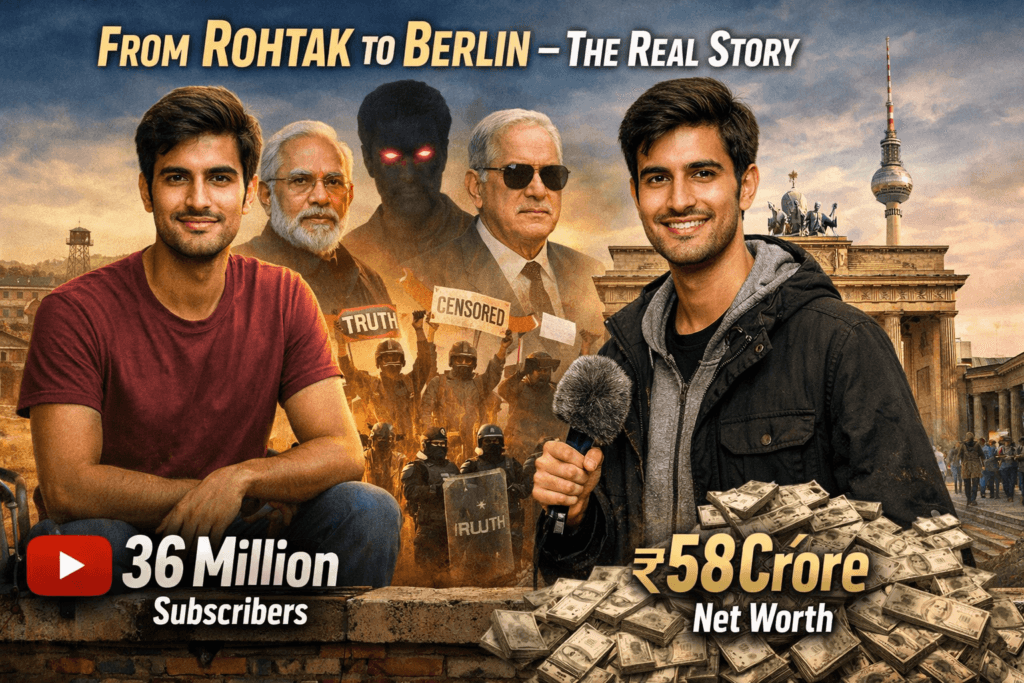
As of June 2025, he has over 36 million subscribers and 7 billion total views across all his channels. He was named to Time magazine’s Next Generation Leaders list in 2023. His net worth is estimated at approximately ₹58 crore. He has a Netflix India show, a Spotify podcast, a YouTube Academy, and five regional language channels. He built all of this by consistently saying things that a significant portion of his potential audience did not want to hear — and by saying them so carefully, so evidentially, and so persistently that even the people who disagreed found it difficult to look away.
That is not a viral strategy. That is a decade of work.
He is a mechanical engineer from Haryana who moved to Germany, started a travel vlog that nobody watched, pivoted to political commentary that half the country hates and half the country worships, and built 36 million subscribers doing it from a flat in Berlin.
— The kind of story that doesn’t fit neatly on a motivational poster, which is exactly what makes it worth telling
Rohtak to Karlsruhe: The Engineering Detour That Shaped Everything
Dhruv Rathee was born on October 8, 1994 in Rohtak, Haryana — the same state that produced CarryMinati from Faridabad, a city about 80 kilometres away. Two creators from the same region, both building enormous digital careers in formats nobody had validated yet, both doing it without the infrastructure of Delhi or Mumbai behind them. The parallel is worth noting.
Rathee attended Delhi Public School, RK Puram — a school in Delhi, which means his family had the means and the inclination to move him toward the best available education. His parents, Mahavir Rathee and Urmila Rathee, encouraged an interest in science, history, and current affairs from early on. The intellectual curiosity was cultivated at home before it was expressed online.
At 17, he moved to Germany to study at the Karlsruhe Institute of Technology — one of Germany’s most prestigious technical universities, consistently ranked among Europe’s top engineering schools. He completed a Bachelor’s degree in Mechanical Engineering and subsequently a Master’s degree in Renewable Energy Engineering at the same institution. He was not a struggling student trying to stay afloat in a foreign country. He was a good student, engaged with his subject, who happened to start making videos on the side in 2013 about things he found interesting — initially, the environmental and energy topics he was studying.
The pivot to political commentary came from a specific moment: the 2014 Indian general elections. Like many young, educated Indians watching from abroad, Rathee was following the campaign closely. He made a video analysing the BJP’s performance and the questions around the incoming government’s promises. It got significantly more views than his environmental content had. He noted this and adjusted — not immediately, not dramatically, but gradually and deliberately. By the time he completed his Master’s degree, the channel had found its voice.
The Specific Courage of Saying Unpopular Things Carefully
Here is what distinguishes Dhruv Rathee’s approach from the vast majority of political commentary on Indian YouTube, and why it is worth treating as a genuine case study in building a sustainable audience around difficult content.
Most political content on social media works through emotion — outrage, fear, tribal solidarity. The creator picks a side, gives the side’s audience what they want to hear, grows an audience of people who already agree, and generates engagement through confirmation. This works in the short term. It produces rapid audience growth and good revenue for a while. It also produces an audience that is loyal to the side rather than to the creator — which means the moment the creator says something that doesn’t fit the tribal consensus, the audience turns.
Rathee’s approach from 2014 onwards was structurally different. Every video he made was evidence-based: data, sources, citations, documented facts. The argument was always built from the evidence outward, not the conclusion inward. He would take a government policy, look at its stated goals, find the data on whether those goals were being met, and present the gap — without theatrical outrage, without tribal language, with the specific vocabulary of someone trained to think in terms of evidence and mechanism.
This approach made him harder to dismiss. You could disagree with his framing. You could argue his source selection was biased. What you couldn’t easily do — and what large sections of his opposition tried and failed to do — was find factual errors in the underlying data. His engineering brain, applied to political analysis, produced content with a different structural integrity than opinion-driven commentary. It was slower to make. It was harder to refute. And it built a different kind of audience loyalty — one based on trust in the process rather than agreement with the conclusion.
The Controversies — All of Them, Honestly Reported
A Dhruv Rathee profile that doesn’t address the controversies honestly is not actually a Dhruv Rathee profile. The controversies are part of the story — and how he handled them is, in some ways, the most instructive part.
1. The Ministry of I&B Map Block (September 2022)
In September 2022, Rathee posted a video about Pakistan’s political crisis. The video was blocked in India by the Ministry of Information and Broadcasting because it contained a map of India that did not align with India’s official national position on Kashmir. This was not a political attack on his content — it was a technical violation of Indian law regarding disputed territory maps. Rathee acknowledged the map error and complied with the removal, without making a cause célèbre out of it. He continued making content.
2. The Dabur Copyright Case (March 2023)
In March 2023, Dabur India filed a complaint against Rathee’s video “The dark side of cold drinks,” which critically examined the health claims of cold drinks including Dabur’s products. The Calcutta High Court ordered the video to be taken down pending the case. This was a genuine legal challenge — a large corporation using legal mechanisms to suppress critical content from a media figure. Rathee continued operating. He has since spoken about the case as an example of why independent digital media faces structural vulnerabilities that legacy media does not, because legacy media has legal teams and independent creators largely don’t.
3. The Pahalgam Attack Controversy (2025)
Following the 2025 Pahalgam attack, Pakistani news channels aired clips of Rathee’s earlier videos criticising the Indian government’s security failures — clips taken out of context and used in ways Rathee explicitly did not intend and did not endorse. He stated publicly that his content was being misused. This was one of the more uncomfortable positions any Indian creator could find themselves in: having their own factual content weaponised by actors with entirely different agendas. His response was to clarify, not to retract — maintaining that the original analysis was accurate while clearly objecting to how it was being deployed.
4. The AI Sikh Gurus Thumbnail (May 2025)
In May 2025, Rathee published a video titled “The Rise of Sikhs” which used an AI-generated thumbnail depicting Sikh gurus — a practice that the Sikh community considers a violation of religious tenets, since traditional Sikh doctrine prohibits pictorial depictions of the Gurus. The backlash was immediate and significant, including formal complaints from the Shiromani Gurdwara Parbandhak Committee, the apex religious authority for Sikhs. Rathee removed the video. This was a genuine error of cultural sensitivity, acknowledged and acted on without extended public defensiveness — which is, in the creator world, a more honest response than most people manage.
The throughline in all four controversies is the same: a creator willing to face institutional pressure, corporate legal action, geopolitical weaponisation of his content, and community backlash — and to keep making content anyway, adjusting where he was actually wrong, holding his position where he had the evidence. That is not comfortable. It is, however, consistent. And twelve years of consistent content under sustained pressure is why he has 36 million subscribers rather than a fleeting viral moment.
The Germany Factor: What Living Abroad Did to His Content
One of the most underexamined aspects of Rathee’s career is the effect that living in Germany — specifically in Berlin, a city with a particular cultural relationship to political speech and media independence — had on the kind of content he made and the way he made it.
Operating from Germany gave him several things that Indian-based creators covering similar topics simply don’t have. First, legal distance — the Indian government’s ability to pressure him directly was limited by jurisdictional constraints. His channels are international; his physical person is not in India. This doesn’t make him immune to content removal, but it changes the calculus significantly compared to a creator operating from Delhi or Mumbai.
Second, it gave him the perspective of genuine distance — the ability to look at India from outside, in a country with strong institutional commitment to press freedom and political speech, while retaining deep cultural connection to the audience he was speaking to. He grew up in Rohtak. He speaks Hinglish with natural authenticity. He understands the cultural references, the political pressures, the social dynamics of the audience he addresses. But he does not live inside the information environment they inhabit — which means he sees certain things more clearly than they can from inside it.
Third, the engineering education gave him something that most political commentators lack: a framework for thinking about evidence and mechanism that predates his commentary career. He did not become analytical because he decided to be. He was trained to think analytically and then applied that training to a domain where analytical thinking is rare.
The Business He Built Around the Channel
The 36 million subscribers are the headline. The business behind them is more interesting.
Rathee’s estimated monthly YouTube income from ad revenue alone is between $1.5–1.9 million, according to estimates based on his channel’s view counts, engagement rates, and YouTube’s advertiser rates for his content category. This is before brand partnerships, before the Netflix India Decode series, before the Spotify Maha Bharat podcast, before the Dhruv Rathee Academy launched in partnership with Nas Academy, before the DW Travel hosting work.
In April 2024, he launched five additional YouTube channels — in Tamil, Telugu, Bengali, Marathi, and Kannada — specifically to distribute dubbed versions of his existing content to regional language audiences. This is not a vanity play. This is a deliberate market expansion strategy: the same content, the same production investment, distributed into five new audiences with different mother tongues. The marginal cost of doing this is relatively low once the Hindi content exists. The potential audience expansion is enormous — India has hundreds of millions of Tamil, Telugu, Bengali, Marathi, and Kannada speakers who consume content primarily in their first language.
This is the same instinct Ratan Tata applied to the JLR acquisition — finding an undervalued asset and deploying existing expertise into it at marginal cost. The best business decisions often look obvious in retrospect and counterintuitive at the time. Distributing existing content into regional languages in 2024 is not obviously brilliant — until you remember that India’s next 500 million internet users are not going to be consuming English or Hindi content primarily.
What Changed: From Modi Supporter to India’s Most Famous Political Critic
One of the most interesting — and rarely acknowledged — aspects of Rathee’s public journey is that he was not always a critic of the ruling government. In 2014, when Modi came to power, Rathee was broadly supportive. His early content on the BJP’s agenda was analytical but not hostile. He was, by his own description in later interviews, genuinely interested in whether the government’s stated promises would materialise.
What changed was the evidence. As the years progressed and he continued applying the same analytical framework — stated goal, available data, measured outcome — the gap between the government’s claims and the documented reality consistently produced content that was critical. Not because he set out to be critical. Because the evidence produced criticism.
This is a genuinely important distinction and he has been careful to make it clearly in his own explanation of his evolution. The approach didn’t change. The conclusion followed from the approach, and the approach was applied consistently to a government whose documented record produced consistent gaps between promise and delivery. Whether you agree with his conclusions or not, the methodology — start from evidence, follow it to wherever it leads, publish the result — is one that most commentators, on any side of any debate, don’t actually practise.
The Tram Meeting That Changed His Personal Life
In 2014, Dhruv Rathee was 19 years old, commuting daily to an internship in Germany. On a tram, he met a German student named Juli Lbr who was commuting to school. They were both 19. They started talking during the shared commute. The conversations continued. The relationship deepened over several years until they married in November 2021 at the Belvedere Palace in Vienna — a ceremony that, predictably, several million of his subscribers treated as a personal event they had a stake in.
Juli Lbr is a German citizen, a medical student, and a part-time camerawoman for his vlogs. In September 2024, they had their first child, a son. She appears in his travel content as a real person rather than as a social media prop — not performing a couple’s brand, just being in his life in a way that happens to be partly public. In an internet world full of manufactured relatability, this distinction matters.
The personal life detail is relevant to the professional story for one specific reason: the creator who built an audience by being honest about hard things is also honest about his life. There is no performed version of Dhruv Rathee. The person who makes the political videos and the person who posts the tram-meeting story and the person who removes the video when he gets it wrong — they appear to be the same person. In a media landscape full of carefully managed personas, that consistency is itself a form of brand equity that is very difficult to manufacture and very easy to destroy.
What His Career Actually Teaches You — Without the Inspirational Gloss
- A niche audience that trusts you is more valuable than a large audience that merely watches you. Rathee’s subscribers are among the most engaged in Indian YouTube. They share his content because they trust it. That trust was built over twelve years of being consistently right about the things he claimed to be right about, and consistently transparent about the things he got wrong. You cannot shortcut that process. It takes the time it takes.
- Your technical background is not separate from your creative career. It is your creative career’s most defensible advantage. His engineering training in evidence-based reasoning is the thing that separates his political content from every other political commenter on Indian YouTube. The degree he did not use professionally, he used completely. The skills you think are irrelevant to what you want to build are almost always the ones that end up defining why what you build is different.
- Saying unpopular true things builds a sturdier audience than saying popular true things. The audience that stays because you confirmed what they already believed leaves the moment you challenge it. The audience that stays because you gave them a reliable method for understanding the world — evidence, verification, analysis — stays even when they disagree with your conclusions. Rathee has grown his channel through multiple political cycles, economic crises, and personal controversies precisely because his audience relationship is not built on tribal loyalty.
- Geography is not destiny for digital careers, but distance is a tool if you use it correctly. Being in Germany gave Rathee legal protection, analytical distance, and the ability to continue making content that an India-based creator covering similar topics would have found significantly more difficult to sustain. The career that seems impossible from where you are standing is sometimes genuinely easier from a different position — not better or worse as a person, just positioned differently in relation to the specific constraints you’re navigating.
- When you get it wrong, say so quickly and move on. The AI thumbnail controversy with the Sikh community, the Pakistan map violation, the Dabur case — in each instance, where he was genuinely wrong, he acknowledged it and moved on without extended public self-flagellation or defensive doubling-down. The ability to be wrong quickly and move forward is, in a long career, more valuable than the ability to be right all the time — because being right all the time isn’t available as an option.
The Number That Puts It All in Context
36 million subscribers. 7 billion total views. ₹58 crore net worth. Time Next Generation Leaders. Netflix India. Spotify. Five regional language channels. A husband, a father, a son of Rohtak who moved to Germany at 17 and spent the next twelve years saying things that made a very large number of very powerful people uncomfortable.
He did not build this by being safe. He did not build this by being agreeable. He built it by being consistent — consistent in his method, consistent in his standards of evidence, consistent in his willingness to say the thing that the data said regardless of who it was inconvenient for.
There are easier ways to build 36 million subscribers on YouTube India. There are faster ways. Dhruv Rathee’s way is the sustainable way — the one that builds something that lasts because it is built on something real.
Twelve years. Thirty-six million. From a flat in Berlin.
More From SarcasticMotivators
The other creator from Haryana who built a different kind of empire from a different kind of starting point: CarryMinati Started YouTube at 10 and Built a ₹40 Crore Brand. You’ve Been “Planning” Since 2019.
On showing up under hostile conditions and continuing anyway: Hardik Pandya: The Guy Who Got Booed at His Own Team’s Ground and Still Took Wickets
On performing in small, unnoticed arenas until you can’t be ignored: IPL 2026 Auction: ₹14 Crore for an Uncapped Player — Because Why Not
On nineteen seasons of consistent process over noise: MS Dhoni’s Retirement That Never Happens: A Love Story in Yellow
On why you’re still not started: Congratulations, You Googled “How to Be Motivated” Instead of Actually Doing the Thing
On the five-year plan that didn’t survive contact with reality: Your 5-Year Plan vs What Actually Happened: A Tragedy in Three Acts
On the Monday you need to show up for: Dear Monday: It’s Not You, It’s Me (Actually, It’s You)
The Delhi boy who built Bollywood with no connections: Shah Rukh Khan Had No Godfather in Bollywood and Still Won — So What’s Your Excuse?
The quietest empire, built without Instagram: Ratan Tata Never Flexed on Instagram. He Just Built an Empire. Noted.
On what Indian parents think pays versus what 2026 actually shows: Every Indian Parent’s Career Advice vs What Actually Pays in 2026
Frequently Asked Questions
Who is Dhruv Rathee and what does he do?
Dhruv Rathee is an Indian YouTuber, social media activist, and political commentator based in Berlin, Germany. Born in Rohtak, Haryana on October 8, 1994, he holds a Bachelor’s degree in Mechanical Engineering and a Master’s in Renewable Energy Engineering from the Karlsruhe Institute of Technology in Germany. He started his YouTube channel in 2013, initially covering environmental and energy topics, before transitioning to political commentary, fact-checking, and social analysis. As of June 2025, he has over 36 million subscribers and 7 billion total views across all his channels. He was named to Time magazine’s Next Generation Leaders list in 2023. He also hosts a Netflix India show called Decode with Dhruv, a Spotify podcast Maha Bharat with Dhruv Rathee, and runs the Dhruv Rathee Academy online learning platform.
How many subscribers does Dhruv Rathee have in 2025?
As of June 2025, Dhruv Rathee has over 36 million subscribers and 7 billion total views across all his YouTube channels, according to Wikipedia and verified biographical sources. His main channel DhruvRathee is the largest. In April 2024, he launched five additional channels distributing dubbed content in Tamil, Telugu, Bengali, Marathi, and Kannada to reach regional language audiences in India. His main channel alone has over 28–30 million subscribers, with the remainder distributed across the vlog channel, the Shorts channel, and the regional language channels.
What is Dhruv Rathee’s net worth in 2025?
Dhruv Rathee’s net worth as of 2025 is estimated at approximately $7 million, equivalent to roughly ₹58 crore, according to multiple biographical sources including his own published biography. His monthly YouTube income is estimated at $1.5–1.9 million from ad revenue based on his channel’s view count and engagement rates. Additional income sources include brand collaborations, his Netflix India series Decode with Dhruv, the Dhruv Rathee Academy (launched with Nas Academy in 2023), DW Travel hosting work, his Spotify podcast, and merchandise sales.
Why did Dhruv Rathee’s video get blocked in India?
In September 2022, a Dhruv Rathee video about Pakistan’s political crisis was blocked in India by the Ministry of Information and Broadcasting. The reason was technical: the video contained a map of India that did not align with India’s official national position on the Kashmir dispute. Under Indian law, maps of India that show the country’s borders differently from the official government position are prohibited from broadcast. The block was not a commentary on the political content of the video but a legal enforcement of the map regulation. Rathee acknowledged the map error and complied with the removal order without making the incident a major public confrontation.
Was Dhruv Rathee always a Modi critic?
No. Rathee has stated in interviews that in 2014, when the BJP came to power, he was broadly supportive and genuinely interested in whether the government’s stated promises would be delivered. His evolution to a consistent critic of the ruling government happened gradually over subsequent years as he continued applying the same evidence-based analytical framework to government policies and found consistent gaps between stated goals and documented outcomes. He has described this evolution as following the evidence rather than choosing a side — a claim that his critics dispute but that is consistent with the documented methodology of his content across the years.
Where does Dhruv Rathee live and why?
Dhruv Rathee lives in Berlin, Germany, where he has been based since moving there at 17 to study at the Karlsruhe Institute of Technology. He met his wife Juli Lbr — a German citizen and medical student — in Germany in 2014, and they have built their life there. Living in Germany provides him with legal and jurisdictional distance from Indian regulatory authorities, stronger press freedom protections under German law, and the analytical distance of observing India from outside its immediate information environment while retaining deep cultural connection to his Indian audience. In September 2024, he and his wife had their first child, a son, in Germany.