
In 2009, a ten-year-old boy in Faridabad, Haryana — a city best known for being near Delhi rather than for anything it produced — sat down at a computer and uploaded a football tutorial video to YouTube. The video was not good. The channel was called STeaLThFeArzZ. Nobody watched it. There were no subscribers, no views worth counting, no feedback of any kind except the silence of an internet that had not noticed he existed.
He uploaded another one anyway.
Sixteen years later, Ajey Nagar — who the internet knows as CarryMinati — has over 45 million subscribers across his channels, an estimated net worth of ₹40–50 crore, brand deals worth ₹35,000–55,000 per sponsored Instagram post, a Diamond Play Button, a Forbes Asia 30 Under 30 listing, a Time magazine Next Generation Leaders recognition, a Bollywood cameo in a film starring Ajay Devgn and Amitabh Bachchan, and a music catalogue that includes Yalgaar — a track that has over 300 million YouTube views.
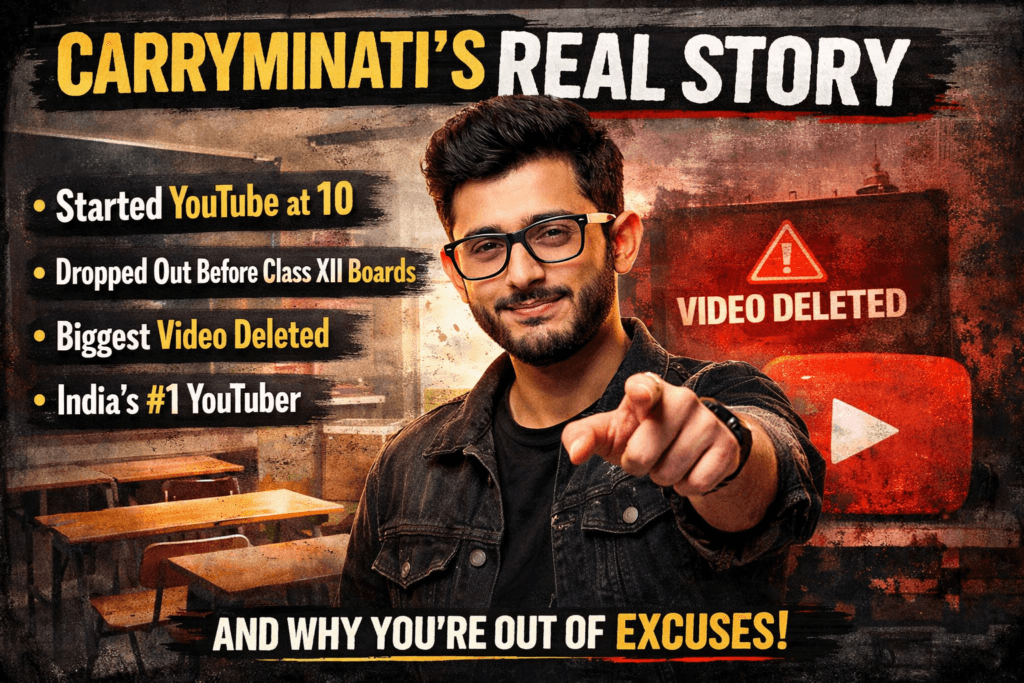
He built all of this from a home studio in Faridabad. He did not go to IIT. He did not go to IIM. He did not go to college at all — he dropped out before his Class XII board exams because, as he has said himself, he was too nervous about his economics paper. He completed his education later through distance learning.
The boy who couldn’t face his economics exam built a multi-crore empire by being the most economically efficient content creator in India — doing more with less, from a city that everyone was leaving, in a language the global internet had not yet decided to take seriously.
He started at 10. He has 45 million subscribers at 26. You have been “almost ready to start” for approximately five years. This is fine.
— The SarcasticMotivators narrator, calmly
Faridabad: The Most Important Detail Everyone Skips Over
Before we talk about the 45 million subscribers or the Forbes listing, let’s talk about Faridabad for a moment. Because Faridabad is a detail that matters and almost every CarryMinati profile skips past it in the first paragraph to get to the more interesting numbers.
Faridabad is an industrial city in Haryana, immediately south of Delhi. It is not a glamorous city. It does not have the creative infrastructure of Mumbai, the tech ecosystem of Bangalore, or the media connections of Delhi proper. In 2009, when Ajey Nagar started posting videos, there was no Indian YouTube creator ecosystem to speak of. There were no role models who looked like him, sounded like him, or came from anywhere near where he came from. There was no roadmap. There was no community of creators in Faridabad who could have told him how to grow a channel, what content worked, how to monetise.
There was just a ten-year-old kid with a camera and an internet connection who thought it might be interesting to make videos.
This is the detail that makes CarryMinati’s story genuinely instructive rather than just impressive. He didn’t have access to the tools or the community that would have made starting easier. He started anyway, in the dark, without feedback, without validation, without any evidence that it was going to work. The first channel failed. The second approach didn’t immediately work either. He kept iterating.
By the time the Indian YouTube creator ecosystem existed — by the time there were enough Hindi-language creators to form a community, enough viewers to support them, enough brand money to pay them — CarryMinati had already been doing it for years. He was not early to a trend. He was early enough to create the trend. The difference between those two things is everything.
The Channel That Kept Changing Until It Found Its Voice
The story of how STeaLThFeArzZ became CarryMinati is actually the most useful part of his career for anyone trying to build something — because it is the story of repeated pivoting without quitting.
First channel: STeaLThFeArzZ (2009). Football tutorials. Nobody watched. He kept going.
Second era: AddictedA1 (2014). Gaming footage with reactions. The format that would eventually work — but not yet. The channel existed. It grew slowly. He kept going.
Third era: CarryDeol (2015). Counter-Strike gameplay footage while impersonating Sunny Deol. This is where something clicked — not the gaming, but the impersonation. His voice. His timing. The gap between the violent intensity of a CS:GO match and the specific energy of Sunny Deol’s dialogue delivery was genuinely funny. He had found the ingredient: his personality, applied to a format.
Fourth era: CarryMinati. The channel took its current name and evolved toward roasting — comedic takedowns of music videos, content creators, trends, and internet absurdities delivered in an unmistakable voice. The voice is the product. Loud, fast, Hindi-English switching, expressive beyond anything a script could manufacture, capable of producing a sentence that is simultaneously the funniest thing you’ve heard this week and a legitimate critique of something worth critiquing.
None of this happened in a straight line. It happened through five years of uploading content that wasn’t quite right yet, paying attention to what worked, and adjusting. There was no moment of sudden clarity. There was just consistent output and honest evaluation of what was landing with the small audience that was growing alongside him.
The Board Exam He Skipped — And What It Actually Took Courage to Do
In 2016, Ajey Nagar was supposed to sit his Class XII board examinations. He did not. According to his own account and multiple biographical sources, he was too anxious about the economics paper — not confident he would pass — and made the decision to leave before the exam and pursue YouTube full-time instead. He later completed his Class XII through distance education.
The easy narrative here is: brave kid leaves school to follow his dream, succeeds spectacularly, everyone cheers. The honest narrative is more complicated. Dropping out at Class XII in India is not a culturally neutral act. The pressure to complete board examinations — from family, from society, from the weight of what education represents for an upwardly mobile middle-class family in Haryana — is not trivial. It carries real consequences. It requires a genuine belief that the alternative is worth the social cost of the choice.
Ajey Nagar made that choice at 16 or 17 because by that point his YouTube channel had enough momentum that the alternative seemed real. He was not jumping blindly into the unknown. He had data. The data said the YouTube path was producing results. He made a decision based on evidence — imperfectly, at a young age, under real pressure — and then he continued to build.
This is the specific detail that makes his story different from the romanticised “follow your passion” narrative: he didn’t quit school because following his passion felt good. He quit because his numbers said something real was happening and he needed to choose whether to take it seriously. He chose to take it seriously. He was right. But he chose based on data, not just on feeling.
The YouTube vs TikTok Controversy — When the Platform Deleted His Biggest Video
In May 2020, CarryMinati published “YouTube vs TikTok: The End” — a roast video responding to TikTok creator Amir Siddiqui, who had made a video criticising YouTube creators. The video went viral at a scale that had not been seen in Indian digital content history. It accumulated over 72 million views in six days. It broke records for most-liked non-music video on YouTube India. For one extraordinary week, CarryMinati was not just the biggest creator in India — he was one of the most watched people on the internet.
Then YouTube took it down.
The removal came after multiple complaints from LGBTQ+ activists who identified language in the video that they considered homophobic and harassing. YouTube cited violations of its community guidelines around cyberbullying and harassment. The video — 72 million views, the biggest moment of his career — was deleted. He gained 1.4 million subscribers in the 24 hours after the deletion, making him at that point the fastest-growing channel on YouTube in a single day.
What happened after was instructive. He did not rage-quit the platform. He did not pivot to a rival. He took stock, released “Yalgaar” — a music video that channelled the energy of the controversy into a track — and continued building. The controversy that cost him his biggest video also introduced him to approximately 50 million people who had not previously known he existed. He understood that the attention, even when it came from the worst circumstances, was an asset if he used it correctly.
By 2026, he has 45 million subscribers and billions of total views. The deleted video, in a genuine sense, accelerated rather than ended his trajectory.
What Most People Get Wrong About How He Actually Makes Money
The common assumption is that CarryMinati’s money comes from YouTube ad revenue. This is true but incomplete — and the incomplete part is where the real business lesson lives.
YouTube ad revenue for a channel of his size generates substantial income — estimates range from $500,000 to $1 million annually from YouTube alone. But brand sponsorships dwarf that. Verified sources put his Instagram sponsored post rate between ₹35,000 and ₹55,000 per post — and with 22 million Instagram followers at an engagement rate of approximately 5%, he is one of the most commercially attractive creators in India for brands seeking genuine audience attention rather than inflated follower numbers.
He is the brand ambassador for WinZo — a gaming app — with a deal finalised in January 2022 that involves both content creation and live streaming integration. He has collaborated with gaming brands, consumer electronics companies, and entertainment platforms. His music releases — Yalgaar, Vardaan, Jalwa — generate streaming royalties and YouTube music revenue that are entirely separate from his main content earnings. He dubbed the Hindi version of Free Guy, the Hollywood film — a brand association that extended his visibility into cinema audiences.
The architecture of his income is what a modern creator business looks like: multiple revenue streams, each reinforcing the others, none fully dependent on any single platform’s algorithm treating him favourably on any given week. He did not build a YouTube channel. He built a brand that distributes through YouTube, Instagram, music platforms, live streaming, film, and endorsements simultaneously.
He started learning this at 10. Most people have not started learning it yet.
Ajey Nagar started his first YouTube channel at 10 years old. It failed. He started another one. It failed differently. He started another one. It eventually worked. The entire process took five years of consistent uploading before it became undeniable. You have been deciding whether to start your thing for approximately the same amount of time. One of these approaches produces 45 million subscribers.
On what starting before you’re ready actually looks like: Congratulations, You Googled “How to Be Motivated” Instead of Actually Doing the Thing
The Charity Work That Doesn’t Make the Headlines
One of the least-discussed aspects of CarryMinati’s career is the consistent use of his platform and his reach for charitable causes. This is not performative philanthropy — it predates the period when being seen to do good things became commercially important for creators.
In 2018, he hosted a charity livestream for victims of the Kerala floods. In 2019, he raised funds for families affected by Cyclone Fani in Odisha through his CarryIsLive channel. In 2020, he streamed for Assam and Bihar flood victims and raised money for families of Pulwama attack victims. In 2023, he hosted a four-hour charity livestream for the Odisha train crash victims — raising over ₹11.87 lakhs in a single session, including ₹1.5 lakhs from his own contribution. For the Australian bushfire victims during COVID, he streamed again.
This is a creator who has used his reach as a tool for his audience to do good — not occasionally, not as a PR exercise, but repeatedly and consistently across six years of disasters and crises. He does not make these streams his identity. He just does them and moves on. The care for the audience that shows up in his content exists equally in how he responds when his audience is hurting.
The Introvert Behind the Loudest Voice on Indian YouTube
Here is the detail that surprises most people who know CarryMinati only through his content: in real life, Ajey Nagar is an introvert. He has spoken about this openly — about social anxiety, about the gap between the person who exists in his videos and the person who exists in a room full of strangers. The voice that fills his videos is not an act, exactly — the energy is real — but it is a version of himself that he accesses in the specific context of creation that he does not carry into every social situation.
This matters because it dismantles the assumption that successful creators are people who are naturally extroverted, naturally performing, naturally comfortable in the spotlight. CarryMinati’s spotlight is the camera in his home studio in Faridabad. That’s where he’s most himself. The public-facing career that looks like perpetual confidence and energy is built on a foundation of enormous comfort with one specific creative environment — not a general social confidence that translates everywhere.
He has advocated publicly for mental health awareness and has spoken about the pressure that comes with a platform of his scale — the expectation of constant output, constant relevance, constant growth. He does not perform invulnerability. He acknowledges the weight of what he’s built and encourages his audience to take their mental health seriously. For a creator whose brand is loud, fast, and aggressively funny — this counterpoint is worth knowing about.
What CarryMinati’s Story Actually Teaches You — Stripped of the Hype
- Start before the infrastructure exists. In 2009 there was no Hindi YouTube creator economy. CarryMinati started anyway. By the time the ecosystem existed, he was already in it. The people who wait for the right moment to enter a new field always arrive after the people who started when it was uncertain. Starting early in an uncertain space is not reckless — it is, in most cases, the only way to be genuinely early.
- Pivot the format, not the commitment. STeaLThFeArzZ failed. AddictedA1 grew slowly. CarryDeol found something. CarryMinati refined it. At no point did he quit YouTube — he quit formats that weren’t working and replaced them with formats that were. The commitment to the medium was constant. The specific approach to the medium was flexible. This distinction separates the people who find their voice from the people who give up before finding it.
- Your platform’s removal of your content is not your career’s end. YouTube deleted his biggest video. He had 72 million views. They deleted it. He gained 1.4 million subscribers in 24 hours after the deletion and released Yalgaar. The controversy was the catalyst, not the conclusion. External platforms can remove your content. They cannot remove your audience relationship if that relationship is real.
- Build multiple revenue streams from the beginning. CarryMinati never relied on a single income source. YouTube ads, brand deals, music, live streaming, film dubbing, brand ambassadorships — these are not things he added after success. They are part of how he structured his career from the point where it became financially real. The creator who earns from one source is one algorithm change away from a serious problem. The creator with five income streams is not.
- The audience can tell if you care. The charity streams — six years of them — are not marketing. They are evidence of a relationship with the audience that goes beyond content consumption. CarryMinati’s audience stays because they trust that the person behind the camera is real. That trust is not manufactured by a social media strategy. It is built one honest interaction at a time, over sixteen years, starting from a failed football tutorial channel in 2009.
The Final Uncomfortable Truth
CarryMinati is 26 years old. He has been a working creator for 16 years — since he was ten. He has failed publicly, been cancelled publicly, had his biggest video deleted publicly, and come back from all of it to become the most subscribed individual YouTuber in India.
He did not do this with a college degree. He did not do this from a major city with a creative infrastructure. He did not do this with industry connections or family money or any of the traditional markers of a head start.
He did it from Faridabad. From his home studio. With a camera, an internet connection, and a voice that he spent five years finding and ten more years sharpening.
You have been “planning to start” for roughly five years. You have better equipment than he had in 2009. You have access to more tutorials, more community, more infrastructure, more examples of what works and what doesn’t. You have every advantage he didn’t have when he began.
The only thing he had that you haven’t started using is the first upload.
What are you waiting for, exactly?
More From SarcasticMotivators
On showing up when conditions are actively hostile: Hardik Pandya: The Guy Who Got Booed at His Own Team’s Ground and Still Took Wickets
On performing in the obscure leagues before the big ones notice: IPL 2026 Auction: ₹14 Crore for an Uncapped Player — Because Why Not
On 19 seasons of consistency over noise: MS Dhoni’s Retirement That Never Happens: A Love Story in Yellow
If you’re still in the researching phase instead of the doing phase: Congratulations, You Googled “How to Be Motivated” Instead of Actually Doing the Thing
On direction over destination — and why the five-year plan is often the wrong tool: Your 5-Year Plan vs What Actually Happened: A Tragedy in Three Acts
On showing up for the Monday that could change things: Dear Monday: It’s Not You, It’s Me (Actually, It’s You)
The Bollywood outsider who arrived with nothing and built everything: Shah Rukh Khan Had No Godfather in Bollywood and Still Won — So What’s Your Excuse?
The man who built an empire without flexing and gave most of it away: Ratan Tata Never Flexed on Instagram. He Just Built an Empire. Noted.
Frequently Asked Questions
When did CarryMinati start YouTube?
CarryMinati — real name Ajey Nagar — started uploading to YouTube at age 10, in 2009 or 2010 depending on the source, with a channel called STeaLThFeArzZ where he posted football tutorial videos. The channel did not gain traction. His current main channel CarryMinati has been active under various names since 2014, starting as AddictedA1, then CarryDeol in 2015, before being renamed CarryMinati. As of January 2026, his main channel has over 45 million subscribers.
What is CarryMinati’s real name and where is he from?
CarryMinati’s real name is Ajey Nagar. He was born on June 12, 1999, in Faridabad, Haryana — a city immediately south of Delhi. He attended Delhi Public School Faridabad before dropping out before his Class XII board examinations, which he later completed through distance learning. He continues to work from Faridabad, producing videos from his home studio there rather than relocating to Mumbai or Delhi for his career.
What is CarryMinati’s net worth in 2025?
CarryMinati’s estimated net worth as of 2025 is approximately ₹40–50 crore (USD 4–6 million), derived from multiple income streams including YouTube ad revenue from his 45 million subscriber channels, brand sponsorships (estimated ₹35,000–55,000 per sponsored Instagram post), brand ambassador agreements such as his WinZo deal, music streaming royalties from tracks including Yalgaar and Vardaan, and other commercial collaborations. His YouTube ad revenue alone is estimated at approximately $500,000–1 million annually.
Why was CarryMinati’s YouTube vs TikTok video deleted?
CarryMinati published “YouTube vs TikTok: The End” in May 2020, a roast video responding to TikTok creator Amir Siddiqui. The video accumulated over 72 million views in six days and broke records for the most-liked non-music video on YouTube India. YouTube subsequently removed it following multiple complaints citing violations of community guidelines around cyberbullying and harassment, with LGBTQ+ activists specifically flagging language in the video they considered homophobic. Despite the removal, CarryMinati gained 1.4 million subscribers in 24 hours following the deletion — the fastest single-day subscriber growth on YouTube at the time.
Did CarryMinati drop out of school?
Yes. Ajey Nagar left Delhi Public School Faridabad before sitting his Class XII board examinations. By his own account, he was too anxious about the economics paper and made the decision to leave formal schooling and pursue his YouTube career full-time instead. He subsequently completed his Class XII through distance education. His decision was made at a point where his YouTube channel had already built sufficient momentum to make the alternative path financially credible — it was not a purely impulsive choice but one informed by the channel’s existing growth data.
How many subscribers does CarryMinati have?
As of January 2026, CarryMinati’s main channel CarryMinati has over 45 million subscribers, making him one of the most subscribed individual YouTubers in India and Asia. His gaming channel CarryIsLive has over 12 million subscribers. He also has a third channel CarryMinati Productions Official for vlogs and behind-the-scenes content with over 1 million subscribers, and CarryMinati Shorts with approximately 1.9 million subscribers. His combined total across all channels exceeds 60 million subscribers.