
Cast your mind back five years. Maybe it was a New Year’s Eve — champagne in hand, phone notes open, spirit fully willing. Maybe it was after a particularly inspiring conversation with someone who seemed to have it together. Maybe it was a quiet Sunday afternoon when you suddenly felt the rare and powerful combination of clarity and ambition arriving at the same time.
You made a plan. A proper one. Five years from now, you told yourself, things would look very different. The career would be sorted. The savings would be building. The side project would be real. The fitness would be consistent. The city you actually wanted to live in — you’d be there by then. Five years felt like a generous runway. More than enough time. You’d be a completely different person, operating at a completely different level.
So. How did that go?
If your five-year plan landed exactly where you aimed it, you are either a statistical outlier or you aimed very low. For the rest of us — which is most of us, if we’re being completely honest — the plan met reality somewhere along the way and the two of them had a difficult conversation. The plan did not win that conversation.
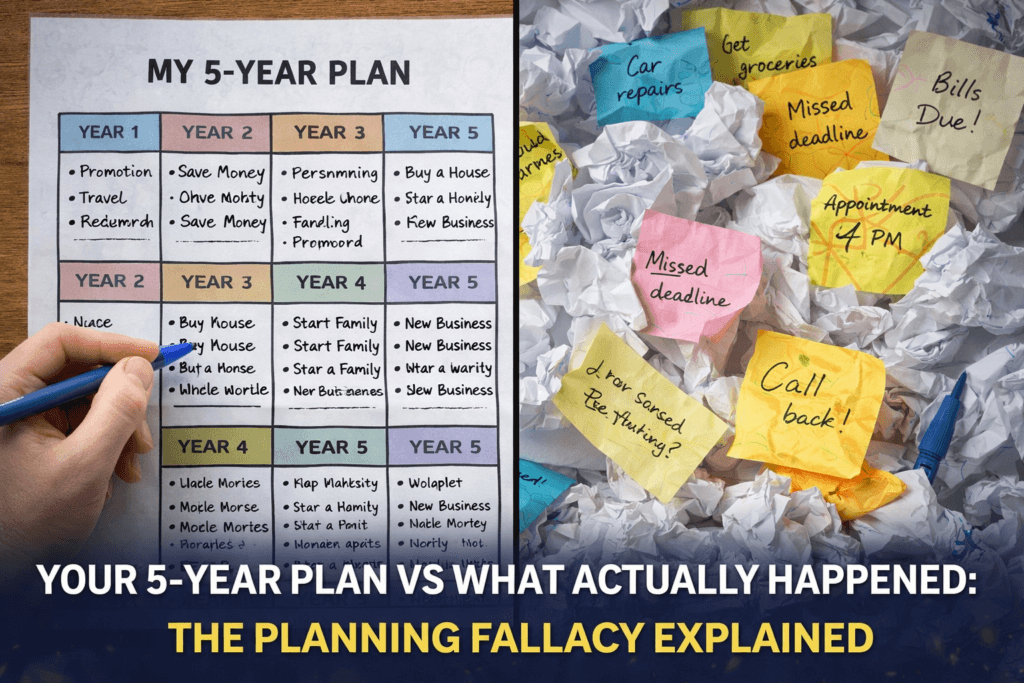
The five-year plan exists in a version of your future where nothing unexpected ever happens. That version of your future does not exist.
— A fact that Kahneman and Tversky spent decades proving, so you don’t have to
Act One: The Plan (Optimistic, Confident, Doomed)
Here is what happens inside your brain when you make a five-year plan. You sit down, you imagine the future, and you run a mental simulation of how things will go. In that simulation — without realising it — you are imagining a version of the next five years in which everything proceeds smoothly. The job search goes well. The skills you need to develop get developed on schedule. The relationships cooperate. The health holds. The economy behaves. The unexpected setbacks, the family emergencies, the global pandemics, the career pivots you didn’t see coming — none of these appear in the simulation, because they are by definition things you haven’t imagined yet.
This is called the Planning Fallacy — a cognitive bias first identified by psychologists Daniel Kahneman and Amos Tversky in 1979. Their definition: the tendency to underestimate the time, costs, and risks of future actions while simultaneously overestimating their benefits. Kahneman later expanded this in his landmark 2003 paper with Dan Lovallo to describe what he called the “inside view” problem — when you plan, you focus entirely on the specific details of your plan and almost completely ignore what he called the “outside view”: the base rate of how similar plans have actually performed historically.
In plain language: you make plans based on how you imagine things going, not based on how things have actually gone for people who’ve tried the same thing before.
The research on this is both illuminating and faintly devastating. A study of psychology students found that only 30% completed their senior thesis in the time they predicted — and this was a task they’d watched classmates struggle with for years. A survey of Canadian taxpayers found they filed their returns about a week later than they predicted — even though they knew from past experience that they always ran late. The Sydney Opera House was originally budgeted to cost $7 million and take four years. It cost $102 million and took fourteen years. The planning fallacy doesn’t spare architecture, or government, or people with PhDs. It’s built into the human brain.
Act Two: The Reality (Messier, Slower, Occasionally Better)
So the plan meets reality. This usually happens not in one dramatic moment but in a slow, accumulating series of small divergences. The promotion takes longer than expected. The savings goal gets interrupted by an emergency. The city move gets complicated by a relationship. The side project stays a side project because the day job keeps expanding to fill available time. The fitness habit starts and stops and starts and stops again.
None of these things make you a failure. They make you a normal human being operating in a world that doesn’t consult your five-year plan before generating new variables.
What’s interesting — and this part is genuinely useful — is that the research also shows something the planning fallacy pessimists don’t always mention. People who make plans, even plans that don’t land as intended, consistently do better than people who make no plans at all. A 2024 meta-analysis published in European Review of Social Psychology — covering 642 tests across different types of planning — found that forming concrete implementation intentions (specific if-then plans) significantly improved follow-through on goals compared to simply having the goal without a plan.
The problem isn’t planning. The problem is planning as if the future will be identical to your best-case simulation of it, and then treating every deviation from that simulation as evidence that something has gone wrong with you rather than with the forecast.
The Three Specific Cognitive Traps Inside Every 5-Year Plan
1. The Optimism Bias. Your brain is structurally wired to believe that you, specifically, are less likely to experience bad outcomes than the average person. This is not modesty talking — it’s neurology. Research by Tali Sharot at University College London showed that the human brain literally processes optimistic information more thoroughly than pessimistic information when imagining the future, even when the pessimistic information is more statistically relevant. First-time entrepreneurs believe their business is more likely to succeed than industry base rates. First-time buyers believe they’re less likely to be affected by property market downturns. You believe your five-year plan is more likely to work than the base rate of similar plans suggests — because your brain is physically better at imagining the good version than the bad one.
2. The Inside View Problem. When Kahneman asked a curriculum-development team how long their project would take, they said two years. When he asked them what the base rate for similar projects was — how long comparable projects had historically taken — they said: between seven and ten years, and some were never finished. He then asked: so how long will yours take? Two years, they said. This is the inside view problem. We know the historical data. We just don’t believe it applies to us. Your five-year plan is the curriculum team’s two-year estimate. You know people who made similar plans and took longer. You don’t believe that applies to your specific situation.
3. Motivated Reasoning. Plans feel good. A detailed, ambitious five-year plan produces a genuine psychological reward in the present. It makes you feel organised, forward-thinking, in control. This reward is real — but it’s the reward for planning, not for executing. The brain does not cleanly distinguish between “I have planned to achieve this” and “I have achieved this.” The feeling of having a plan satisfies some of the same psychological need as the feeling of having done the work. Which is why people with very detailed plans sometimes make less progress than people with rougher plans who spend more time executing — the planners already got their dopamine hit from the planning itself.
Act Three: The Lesson (Which Is Not What You Think)
Here is where most articles about the planning fallacy go wrong. They conclude: therefore, lower your expectations. Make more realistic plans. Account for uncertainty. Add a 50% buffer to your timelines. All of this is technically correct advice and also misses the point completely.
The real lesson from forty years of planning fallacy research is not “plan less ambitiously.” It’s “hold your plan more loosely while executing it more consistently.”
The plan is not the destination. It’s a working hypothesis about the path. And like any hypothesis, it needs to be updated when new data arrives — not abandoned, and not defended past the point where the evidence supports it. The people who use five-year plans well don’t actually plan five years ahead in detail. They plan one year with specificity, the next year in broad strokes, and years three through five as direction rather than destination. Then they review quarterly and update honestly.
THE SARCASTIC TRUTH
MS Dhoni did not have a five-year plan for IPL 2026 when he signed his first CSK contract in 2008. He had a season-by-season plan: show up, perform, lead. Nineteen seasons later, he is still there. The five-year planners who played alongside him in 2008 retired. The man who focused on the present season outlasted all of them.
Read the full story: MS Dhoni’s Retirement That Never Happens: A Love Story in Yellow
What the Successful 5-Year Plans Actually Had in Common
After looking at dozens of real-life examples — from career pivots to business launches to the IPL careers we cover on this site — the pattern in the plans that worked is pretty consistent. They share almost nothing with the plans that failed except the initial ambition. What distinguished them was three things:
- Direction over destination. The successful plans set a direction — “I want to be building something of my own in five years” — rather than a specific destination with a specific timeline. When the route changed, the direction held. When Hardik Pandya’s back gave out in 2019, his destination (international cricket career) was threatened. His direction (be the best all-rounder I can be) didn’t change. He came back. Two years later he was lifting trophies again.
- Small visible actions over large invisible plans. Prashant Veer didn’t have a five-year plan that said “sign for CSK for ₹14.20 crore.” He had a season plan: perform well in the UP T20 League this year. That’s it. The plan was small enough to act on immediately, in the present, with the resources he actually had. The ₹14.20 crore was what happened when he executed that small plan consistently.
- Updating the plan when reality provides new information. The worst five-year plans are the ones that get defended. When the evidence says the plan is off track, the rational response is to update the plan. Instead, most people either abandon the entire goal (I failed) or double down on the original plan despite the evidence (I just need to try harder). Neither is correct. The right response is: this specific route isn’t working — what route is available from where I actually am now?
The Specific Planning Mistake Most Indians Make
There is a particularly Indian version of the five-year plan problem that deserves its own paragraph. It goes like this: the plan is made entirely in response to external expectations rather than internal clarity. The goal isn’t “I want to build this thing” — it’s “I should be at this level by this age, because that’s what people like me are supposed to have achieved.” The benchmarks are comparison benchmarks, not personal ones.
This produces plans with a very specific failure mode. They look ambitious from the outside — job title, salary, city, lifestyle markers — but they have no internal engine. Because you’re not actually chasing something you want; you’re running from something you fear, which is being seen to fall behind. Plans driven by fear of falling behind have no fuel once you’ve achieved the minimum escape velocity from that fear. You get the job. You move to the city. You hit the number. And then the plan runs out of energy, because the engine was always negative — avoiding shame — rather than positive — building something that matters to you.
The fix isn’t a better plan. It’s a more honest conversation with yourself about what you’re actually trying to build and why. That conversation is uncomfortable. It’s also the only one worth having.
What to Do With Your Five-Year Plan Right Now
Here’s the practical version. Not a system. Not a framework. Three things that are genuinely supported by research and won’t require you to buy a planner with motivational quotes on the cover.
- Write down where you thought you’d be five years ago, and where you actually are. Not to make yourself feel bad — to get honest about the gap between your planning assumptions and reality. That gap is your personal planning fallacy coefficient. Whatever your gap was last time, your current five-year plan almost certainly has the same bias built in. The research is clear: people who actively compare their predictions to their past performance make meaningfully more realistic future predictions.
- Replace the five-year destination with a two-year direction and a six-month action. “In five years I will be earning X running my own business” becomes “In two years I want to have one paying client for this thing, and in the next six months I will have three genuine conversations with people who might need what I’m building.” The specificity is in the near term. The ambition is in the direction.
- Schedule a quarterly review, not a five-year review. The single most useful habit for managing the planning fallacy is a quarterly check-in where you ask: what has changed since I made this plan, and does that change which next step makes sense? This is not abandoning the plan. This is treating the plan as a living document rather than a prophecy. The plan that gets updated quarterly is the one that actually leads somewhere. The plan written once in a notebook and never reviewed is just journal writing.
The Sarcastic Conclusion You Probably Needed
Your five-year plan was probably wrong. It was almost certainly too optimistic, aimed at a version of your future that assumed a level of smooth progress that life does not typically provide, and built on comparison benchmarks rather than genuine internal clarity about what you’re trying to build.
None of that means the five years were wasted. It means the map didn’t match the territory — which is true of every map, including the ones drawn by people who seem like they have everything figured out. They don’t. They just have better maps of the territory they’ve already crossed, and they update those maps as they go.
So: where are you actually? Not where the plan said you’d be. Where you actually are right now, with the actual resources and actual circumstances in front of you. That’s the starting point. Not the plan. Not the original destination. Here.
Make the next six months plan from there. Make it specific enough to act on tomorrow morning. Hold it loosely enough to update it in three months when reality provides new data.
The five-year version can wait. The six-month version is what actually moves you.
More From SarcasticMotivators
On the subject of showing up despite the plan going sideways — and 33,000 people letting you know how they feel about it: Hardik Pandya: The Guy Who Got Booed at His Own Team’s Ground and Still Took Wickets
The most concrete example of what happens when you focus on the next small step instead of the five-year destination: IPL 2026 Auction: ₹14 Crore for an Uncapped Player — Because Why Not
The man who has been on a “one more season” plan for five consecutive years — and why that might actually be the smarter approach: MS Dhoni’s Retirement That Never Happens: A Love Story in Yellow
And if the reason your plan hasn’t started yet is that you’re still reading about plans instead of making one: Congratulations, You Googled “How to Be Motivated” Instead of Actually Doing the Thing
Frequently Asked Questions
What is a 5-year plan and why do most of them fail?
A five-year plan is a structured personal or professional goal-setting exercise where you map out where you want to be across key life areas — career, finances, relationships, health — five years from now. Most five-year plans fail to land exactly as designed because of the Planning Fallacy: a well-documented cognitive bias identified by Kahneman and Tversky in 1979, which describes our tendency to systematically underestimate the time, costs, and obstacles involved in reaching future goals while overestimating the benefits. Research shows only about 30% of people complete even shorter-term goals in their predicted timeframes. The plans themselves are not the problem — the assumption that the future will cooperate is.
What is the planning fallacy in simple terms?
The planning fallacy is the universal human tendency to make plans that are more optimistic than reality supports — underestimating how long things will take, how much they’ll cost, and what obstacles will appear, while overestimating how smoothly things will go. It was first named by psychologists Daniel Kahneman and Amos Tversky in 1979 and has since been confirmed across hundreds of studies in settings ranging from individual homework assignments to major infrastructure projects. Critically, people know in the abstract that their past plans have run late — but they consistently believe their current plan is different. This is the defining feature of the bias.
How do I make a realistic 5-year plan?
The most research-supported approach to more realistic planning involves three steps. First, use “reference class forecasting” — look at how long similar goals have taken for others who’ve attempted them, and anchor your estimates to those historical outcomes rather than your optimistic internal simulation. Second, plan in decreasing specificity: make your six-month plan very specific, your one-year plan moderately specific, and your three-to-five year plan directional rather than destination-focused. Third, schedule quarterly reviews where you update your plan based on new information. Plans that get updated regularly based on reality consistently outperform plans made once and defended regardless of feedback.
Is it still worth making a 5-year plan?
Yes — with important caveats. Research consistently shows that people who set concrete goals and make plans to pursue them achieve significantly more than people who have goals without plans, or no goals at all. The 2024 meta-analysis by Sheeran, Listrom, and Gollwitzer covering 642 tests confirmed that implementation intentions — specific if-then plans — substantially improve goal follow-through. The five-year plan is not useless; it’s the rigidity of treating it as a fixed prophecy rather than a working hypothesis that causes problems. Set the direction. Make the near-term plan specific. Update it regularly. Hold the destination loosely.
Why does my life never go according to plan?
Because plans are made with incomplete information about the future, using a brain that is structurally biased toward optimistic simulations and against realistic base-rate thinking. This is not a personal failure — it’s a universal human cognitive pattern documented across cultures, ages, and levels of intelligence. The Sydney Opera House ran 1,400% over budget. Canadian taxpayers consistently file their returns a week later than they predict, year after year, despite knowing they always run late. Your life not going exactly according to plan puts you firmly in the majority of all humans who have ever made plans. The question isn’t whether the plan held — it’s whether you updated it and kept moving.
What should I do when my 5-year plan fails?
The most useful response when a five-year plan diverges from reality is neither to abandon the goal entirely nor to redouble effort on a route that has already shown it isn’t working. Instead: assess honestly where you actually are versus where you intended to be, identify specifically what has changed in your circumstances since the plan was made, and ask what the next most useful step is from your current actual position — not from where the plan assumed you’d be. Plans that fail completely in their specifics often still have value in their direction. The question after a plan falls apart is not “did I fail?” but “which direction am I still pointing, and what’s the next step from here?”