
You know what you’re supposed to be doing right now. You know exactly what it is. It’s been sitting there — in a tab, in a notebook, in the back of your head — since at least Tuesday. Could be a project. Could be a business idea you’ve been “almost ready” to start for eight months. Could be something as simple as replying to an email that has been haunting your unread folder since January.
Instead of doing that thing, you opened a browser tab and typed “how to be motivated.” Or “how to stop procrastinating.” Or “how to find motivation when you don’t feel like it.” And now you’re here, reading this. Which, if you think about it carefully, is a spectacular demonstration of exactly the problem you were searching for a solution to.
Welcome. You’re in good company. Millions of people search for motivation every single day — and most of them close the tab, feel briefly inspired, and then do absolutely nothing with any of it. This article is going to try to be different. Not by giving you a five-step system or a morning routine or a list of affirmations. But by being honest about what’s actually happening when you search for motivation instead of creating it — and what, if anything, you can do about it in the next ten minutes.
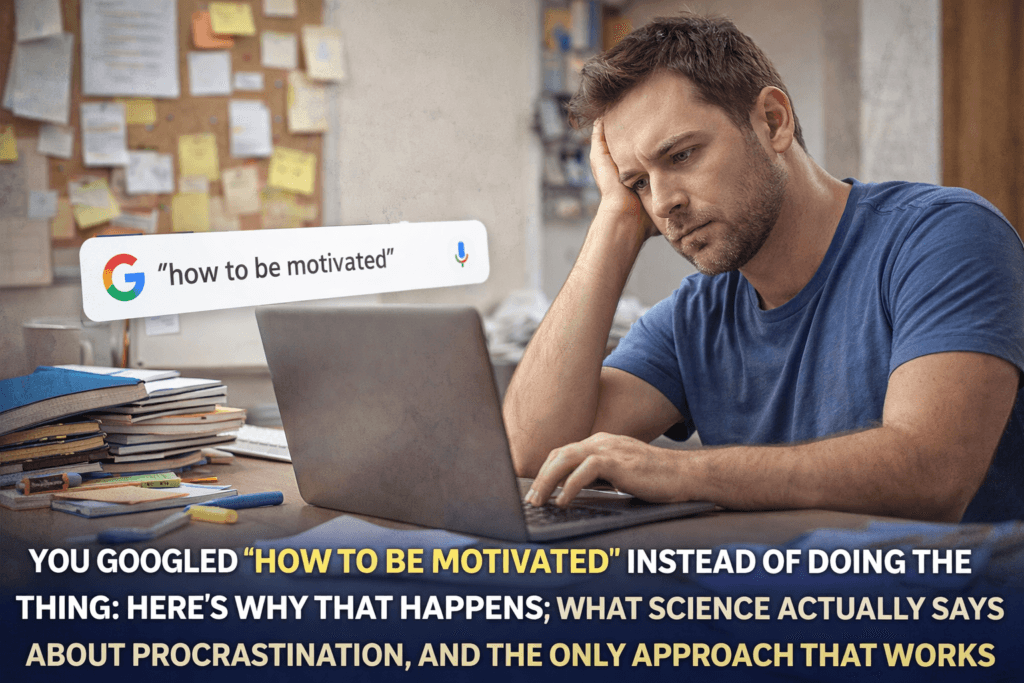
Searching for motivation while avoiding your task is the mental equivalent of reading a cookbook instead of cooking dinner. Very educational. Still hungry.
— The thing nobody who sells motivation courses wants to say out loud
First, the Honest Science — Because You Deserve It
Procrastination is not laziness. This is the single most important thing to understand about it, and it’s also the thing most people with a productivity YouTube channel get completely wrong. Research published in academic journals consistently shows that procrastination is primarily an emotional regulation problem, not a time management problem. You are not bad at managing time. You are trying to manage a feeling.
Here’s how it actually works in your brain. You think about the task. The task produces an unpleasant feeling — anxiety about failure, boredom, frustration, uncertainty about where to start, fear that you’ll do it badly, or just a general heaviness that the task seems to carry. Your brain, which is designed to avoid unpleasant feelings, looks for something that will make you feel better right now. Opening Instagram makes you feel better right now. Watching one more YouTube video makes you feel better right now. Googling “how to be motivated” makes you feel better right now — because doing it feels like progress without the discomfort of actual progress.
This is called mood repair through avoidance, and researchers at multiple universities have confirmed it’s the primary mechanism behind procrastination. You’re not avoiding the task. You’re avoiding the feeling that the task produces. The task just happens to be what’s attached to that feeling.
A 2025 study from UCSB published in BMC Psychology put it plainly: the procrastination problem is a “starting line problem.” The emotional cost of starting feels higher than the reward of finishing. So you don’t start. And every day you don’t start, the emotional cost goes up a little more, making starting feel even harder. This is the loop. If you’ve been “about to start” something for months, this is exactly what’s happening.
Why “How to Be Motivated” Is the Wrong Question
Here’s the thing that every motivational speaker, every self-help book, and every productivity influencer quietly avoids saying: motivation is not the input. It’s the output.
You don’t get motivated and then start working. You start working and then motivation arrives. Every person who has ever built anything meaningful — a career, a business, a creative body of work, a fitness habit — will tell you the same thing if you ask them honestly. The days they felt motivated to work were not the days the work happened. The work happened on the days they showed up anyway, didn’t feel anything particularly inspiring, sat down, and started. The motivation came fifteen minutes into the session, not before it.
This is why “waiting to feel motivated” is not a strategy. It’s a waiting room with no appointment. You can sit there indefinitely and the feeling may never arrive — or it might arrive for twenty minutes on a Tuesday and then vanish for three weeks. Motivation is weather. Discipline is infrastructure. You build infrastructure so you can function regardless of the weather.
MS Dhoni did not feel like keeping wickets at 44 with a bad knee while everyone predicted his retirement. He kept wickets anyway. Motivation was not the point. Showing up was the point.
Read: MS Dhoni’s Retirement That Never Happens: A Love Story in Yellow
The Five Actual Reasons You’re Not Doing the Thing
Stop blaming a lack of motivation. Here are the five real culprits — and none of them are fixed by reading another article about productivity.
1. You’re scared it won’t be good enough
Perfectionism is procrastination wearing a disguise. When you tell yourself you’ll start “when the time is right” or “when you have a better plan,” what you’re usually saying is “I’m afraid to produce something that could be judged and found wanting.” Starting means risking. Not starting means staying safely in the zone where the thing is still potentially perfect because it hasn’t existed yet. The unstarted business idea is always better than the started one — because it’s never been tested. The brain prefers the untested potential to the messy reality.
The fix is not inspiration. It’s lowering your standard for the first draft. Give yourself explicit permission to do it badly. A bad first version you can revise is infinitely more useful than a perfect version that exists only in your head.
2. The task is too big and your brain is refusing to process it
When a task is large and undefined — “start my business,” “get fit,” “fix my career” — the brain has nowhere to grab onto it. It can’t find the starting edge. This produces a specific kind of paralysis that feels like laziness but is actually closer to overwhelm. Research from UCSB found that breaking a task into a smaller subgoal and pairing that subgoal with an immediate small reward produced significantly stronger motivation to start than either strategy alone.
“Start my business” is not a task. “Write a list of three people I could interview about this business idea this week” is a task. The difference is the size of the gap between where you are now and the next step. Keep the gap small enough to step over and your brain stops refusing.
3. You have no clarity on why you actually want this
This is the uncomfortable one. Sometimes the thing you’re avoiding is something you don’t actually want as much as you thought you did. You want to want it — because it sounds good, because someone you respect does it, because you told people you would. But the thing itself doesn’t pull you. No amount of motivation hacks fixes this. The only fix is honesty: do you actually want this, or do you want the idea of it?
If you actually want it, the clarity of why is the fuel. People who know specifically why they’re doing something — not “I want to be successful” but “I want to build this specific thing because it solves this specific problem I care about” — don’t struggle with motivation the way people with vague goals do. The vagueness is what makes it avoidable. Precision makes it urgent.
4. You’re consuming instead of creating
There is a specific kind of procrastination that feels almost virtuous — reading about your field, watching interviews with people who do what you want to do, listening to podcasts about the skills you need to develop, following people on social media who are already where you want to be. All of this feels like preparation. It has the texture of working. It gives you the feeling of momentum without the discomfort of actual movement.
At some point, consuming has to stop and creating has to start. The ratio matters enormously. If you are spending five hours consuming for every thirty minutes creating, you are training yourself to be a very well-informed spectator. Spectators don’t build things. They watch other people build things and feel vaguely bad about it.
5. Your environment is optimised for distraction, not work
The phone is on the desk. Notifications are on. Instagram is one swipe away. WhatsApp messages arrive in real time. The television is in the same room. Your brain is fighting a battle against billion-dollar companies whose entire business model depends on winning your attention away from whatever you’re supposed to be doing. Willpower alone is not a fair fight against that engineering.
This is not about weakness. Studies confirm that even highly conscientious people — those naturally least prone to procrastination — struggle when their environment is saturated with immediate rewards competing with delayed ones. The solution isn’t stronger willpower. It’s a different environment. Phone in another room. Notifications off. One tab open. Forty-five minutes. That’s it.
What Actually Works — The Short, Honest Version
You have been lied to by productivity content. Not deliberately, but consistently. The lie is that there exists a system, a habit stack, a morning routine, or a mindset shift that will make doing hard things feel easy. There isn’t one. Hard things feel hard. That’s definitional. What changes is your relationship to the feeling of hardness — whether you interpret it as a signal to stop or a signal that you’re working on something real.
Here is what the research actually supports, in plain language:
- Start before you feel ready. The feeling of readiness is a reward your brain gives you after you’ve already started, not a prerequisite for starting. Name the emotion you’re feeling about the task — “I feel anxious about this,” “I feel bored by this” — and then start anyway. Research confirms that naming the emotion reduces its power to stop you.
- Make the first step embarrassingly small. Not “work for two hours.” “Open the document.” Not “go to the gym.” “Put on the shoes.” The size of the starting action should be so small that refusing it feels ridiculous. The momentum builds from there.
- Remove the immediate competition. Your phone is more immediately rewarding than your work. That’s not going to change. So remove it from your physical space for the duration of the session. Not muted. Gone. This single change does more than most productivity systems combined.
- Pair the start with a small reward. UCSB research found that telling yourself “after I work on this for twenty-five minutes, I’ll make a good coffee” produced meaningfully stronger motivation than simply resolving to work. The reward doesn’t need to be large. It needs to be specific and immediate.
- Stop optimising the system and start using it. Every hour you spend refining your Notion setup, reorganising your to-do app, or reading about better productivity methods is an hour you didn’t spend working. Systems are useful. Over-engineered systems are procrastination with better aesthetics.
The Real Motivation Is Already There — You Just Can’t See It
Here’s the thing about people who actually get things done — the Dhonis, the Hardiks, the entrepreneurs who built something from nothing. They are not more motivated than you. They are not more disciplined by nature. They are not in possession of some secret energy source that you don’t have access to.
What they have — and this is verifiable from every interview, every biography, every honest account — is a tolerance for starting before it feels good. They have learned, through experience, that the feeling of not wanting to start is temporary and that it goes away once you’re working. They’ve started enough times in bad conditions to trust that the good feeling comes after the start, not before it.
Prashant Veer didn’t wait until the IPL called him. He performed in the UP T20 League — a competition most people have never heard of — until the IPL had no choice but to call him. That’s what ₹14.20 crore looks like when it starts — not glamorous. Not motivated. Just consistent, in a small league, in front of a small crowd, doing the work anyway.
Nobody is coming to watch you work in your equivalent of the UP T20 League. The only person who needs to know you’re doing it is you. The audience comes later — after the work has been done long enough that it’s impossible to ignore.
Before You Close This Tab
You opened this article because something in your life needs doing and you haven’t done it. You know what it is. It hasn’t changed since you opened the tab.
Here is the only thing this article is actually asking you to do: spend the next ten minutes on that thing. Not an hour. Not a productive morning session. Ten minutes. Start without waiting to feel ready. Make the first action small enough to be impossible to refuse. Put your phone in another room first.
Ten minutes in, one of two things will happen. Either you’ll want to keep going — because that’s what actually happens when you start — or you’ll stop after ten minutes having done more than you would have done if you’d kept reading motivational content. Either outcome is better than the alternative.
The tab can be closed now.
Go do the thing.
More From SarcasticMotivators
If the idea of showing up despite the conditions resonates — read about the man who got booed by 33,000 people at his home ground and still bowled: Hardik Pandya: The Guy Who Got Booed at His Own Team’s Ground and Still Took Wickets
And for the most concrete example of what “doing the work before anyone’s watching” actually produces: IPL 2026 Auction: ₹14 Crore for an Uncapped Player — Because Why Not
On the subject of process over noise — 19 seasons of it: MS Dhoni’s Retirement That Never Happens: A Love Story in Yellow
Frequently Asked Questions
Why do I have no motivation to do anything?
The most common reason people feel no motivation is that they’re waiting for the feeling before they start — but motivation actually arrives after starting, not before. Research consistently shows procrastination is an emotional regulation issue: you’re avoiding the uncomfortable feelings a task produces, not the task itself. The fix is to start with a very small action before you feel ready and allow the momentum to build from there. If the feeling of no motivation is persistent and affects multiple areas of life, it may also be worth speaking to a professional, as it can be a symptom of depression or burnout.
How do I motivate myself to study or work when I don’t feel like it?
Start before you feel like it — this is the core principle supported by the most reliable research. Make the first action embarrassingly small: not “study for two hours” but “open the textbook and read one paragraph.” Remove your phone from the room entirely. Pair the start of the session with a specific small reward you’ll give yourself after 25-30 minutes of work. Research from UCSB found this combination — small first step plus immediate reward — produced significantly stronger motivation than willpower or resolve alone.
Is procrastination a sign of laziness?
No. Research published in multiple peer-reviewed journals confirms that procrastination is primarily an emotional regulation failure, not a character flaw or laziness. Procrastinators are typically avoiding the negative feelings a task produces — anxiety, boredom, fear of failure, uncertainty — rather than avoiding the task itself. The American Psychological Association links procrastination to anxiety, depression, low self-esteem, ADHD, and OCD in some cases. Being hard on yourself for procrastinating often makes it worse by adding shame to the existing negative emotions, making the task feel even more threatening to approach.
What is the fastest way to stop procrastinating right now?
Three steps that research supports: first, name the emotion you’re feeling about the task out loud or in writing — “I feel anxious about this” — which research shows reduces the emotion’s power. Second, identify the smallest possible first action, something that takes under two minutes. Third, remove your phone from the room and do that one small thing before checking anything else. The momentum almost always builds from there. You don’t need a new system. You need to start before you feel ready.
Why does reading about motivation feel productive but nothing changes?
Because reading about motivation activates the same reward pathways in your brain as doing something — it produces a small feeling of progress and competence without requiring the discomfort of actual action. This is why consuming productivity content can become its own form of procrastination. The information isn’t the problem. The gap between knowing and doing is the problem. Every article, including this one, is useful only if it changes what you do in the next ten minutes. If it doesn’t, it was entertainment, not a solution.
How long does it take to feel motivated after starting?
Most people report that the resistance to a task reduces significantly within 10-15 minutes of starting. This aligns with what researchers call “task engagement momentum” — once you’re inside a task, the aversion to it drops and forward momentum builds. The hardest part is the first two to five minutes. If you can get through those — with a small enough starting action — the rest becomes significantly easier. This is why the advice to “just start” is technically correct, even if it’s annoying to hear when you don’t feel like starting.