
Picture this. You’re sitting in Abu Dhabi in December 2025, watching the IPL 2026 auction unfold. A 20-year-old from a UP state league you’ve never heard of walks into the bidding pool. His base price is ₹30 lakh. Perfectly reasonable. A nice little starting number for a player with zero international caps and a domestic career measured in months, not years.
Then Chennai Super Kings open their paddle. And then Mumbai Indians. And then Lucknow. And then SRH. And the number on the screen starts climbing like it has somewhere important to be. ₹2 crore. ₹5 crore. ₹9 crore. ₹12 crore. By the time the auction room settled down, Prashant Veer — the 20-year-old left-arm spin allrounder from Uttar Pradesh — had become the most expensive uncapped player in IPL history at ₹14.20 crore.
That’s a 4,633% increase from his base price. In about four minutes.
Then CSK turned around and spent the exact same amount on another uncapped player. Because apparently ₹28 crore on two players nobody outside domestic cricket had heard of was a completely normal Tuesday.
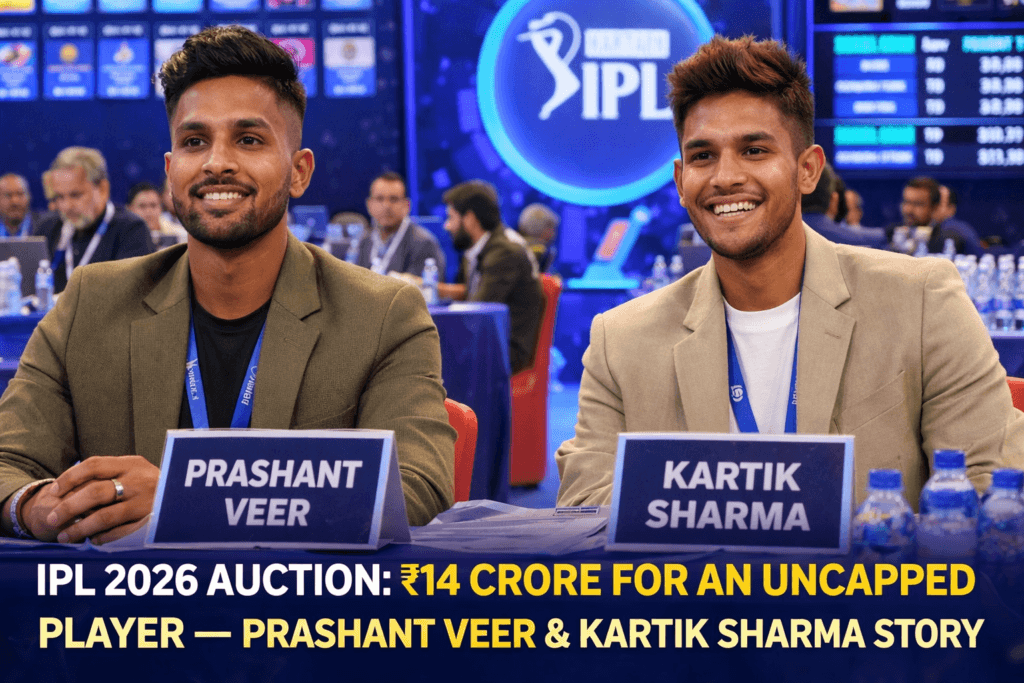
₹30 lakh base price. ₹14.20 crore final bid. That’s not a bidding war — that’s a bidding philosophical crisis.
— The IPL 2026 auction, happening very seriously in Abu Dhabi
So Who Actually Are These Guys?
Before we talk about what this all means, let’s establish that Prashant Veer and Kartik Sharma are genuinely talented players — this isn’t a story about franchises going mad. The ridiculous numbers just make for a better headline.
Prashant Veer — The ₹14.2 Crore Man From Amethi
Prashant Veer grew up in Amethi, Uttar Pradesh — a small town not exactly famous for producing IPL millionaires. He’s a left-arm spin allrounder who first caught serious attention playing for Noida Super Kings in the UP T20 League, where he finished with 320 runs at a strike rate of 155 and chipped in eight wickets. On the domestic circuit this season, he scored 112 runs in T20s at a strike rate of 167 and claimed 12 wickets in nine innings at an economy of 6.45.
His teammates on the age-group circuit called him “Miller” — after David Miller, the South African finisher known for hitting the ball into the next postcode. That nickname, combined with his left-arm spin, made him CSK’s answer to a very specific question they’ve been asking since Ravindra Jadeja departed: who is our batting all-rounder who can also bowl in the middle overs?
The answer, apparently, is a 20-year-old from Amethi who cost ₹14.20 crore. CSK have clearly decided the answer is worth that price.
Kartik Sharma — 28 Sixes, 12 T20s, ₹14.2 Crore
Kartik Sharma is 19 years old and comes from Bharatpur, Rajasthan. He’s a wicketkeeper-batter who emerged from the Rajasthan Premier League in 2023 and spent the next two years quietly building one of the more extraordinary domestic stat lines you’ll see from a teenager. In 12 T20 matches, he has 334 runs at a strike rate of 164 — and 28 sixes. In 11 innings. That’s more than two sixes per innings on average.
In first-class cricket he averaged 43.54 across 11 innings, including three centuries. In List A, he averaged 55.62 with two hundreds. He was the joint-highest six-hitter in the Ranji Trophy this season and the leading six-hitter in the Vijay Hazare Trophy. He also trained with the CSK squad last season, which means Stephen Fleming had already seen him bat against bowlers with IPL experience — and clearly liked what he saw enough to open the franchise’s chequebook very wide.
He’s also managed by JSW Sports — the same agency that handles Neeraj Chopra. So someone with good connections already believed in him before the auction even started.
The Number That Puts This All in Context
Before this auction, the record for the most expensive uncapped Indian player in IPL history was Avesh Khan — ₹10 crore to Lucknow Super Giants in 2022. That was considered outrageous at the time. People wrote articles about it. Experts debated whether it was justified.
Prashant Veer and Kartik Sharma just walked past that record by ₹4.2 crore each. Both of them. On the same afternoon. At the same auction. CSK spent ₹28.4 crore on two players with a combined international cap count of zero.
For further context: Cameron Green — Australia’s established international all-rounder, a player with dozens of Test and ODI appearances — was bought by KKR for ₹25.20 crore at the same auction. Prashant Veer and Kartik Sharma individually cost more than Cameron Green individually. Let that sit for a moment.
| Player | Age | Status | Bought By | Price | Base Price |
|---|---|---|---|---|---|
| Prashant Veer | 20 | Uncapped | CSK | ₹14.20 Cr | ₹30 Lakh |
| Kartik Sharma | 19 | Uncapped | CSK | ₹14.20 Cr | ₹30 Lakh |
| Auqib Nabi Dar | 29 | Uncapped | Delhi Capitals | ₹8.40 Cr | ₹30 Lakh |
| Cameron Green | 26 | Capped (AUS) | KKR | ₹25.20 Cr | ₹2 Cr |
| Avesh Khan (2022) | 25 | Uncapped (then) | LSG | ₹10 Cr | ₹20 Lakh |
The Third Story Nobody Is Talking About
Prashant Veer and Kartik Sharma got most of the headlines. But the third uncapped player who deserves serious attention from this auction is Auqib Nabi Dar — a 29-year-old fast bowler from Baramulla, Jammu & Kashmir, bought by Delhi Capitals for ₹8.40 crore.
Auqib’s story is different from the other two. He isn’t a teenage prodigy with a flashy strike rate. He’s a decade older, grinding through the domestic circuit, waiting for someone to notice. This season he took 15 wickets in seven Syed Mushtaq Ali Trophy matches at an economy under 8. He was the bowler most responsible for Jammu & Kashmir winning their first-ever Ranji Trophy title. He’s been a net bowler for KKR and SRH in past IPL seasons — the guy who bowls in the nets at international batters, helps the team prepare, and then goes home without playing a match.
Delhi Capitals saw what others missed. ₹8.40 crore for a 29-year-old who’d spent years being the best player nobody quite bought. If Auqib Nabi Dar takes wickets in IPL 2026, it’ll be one of the better scouting stories in recent auction history.
What IPL Franchises Are Actually Saying With These Bids
Here’s the thing people miss when they laugh at these numbers. When five IPL franchises start a bidding war over an uncapped 20-year-old, they’re not being irrational. They’re making a calculated bet based on information most of us don’t have.
CSK’s coach Stephen Fleming said it directly after the auction: “We’ve been watching Kartik for some time… sometimes you can hang on to theories and philosophies because of past success but we identified that we needed to shift.”
Delhi Capitals’ head coach Hemang Badani was equally blunt about Auqib Nabi: “Only when someone else is bidding against us can someone go up to 8-8.5 crores. So that tells you this kid has something in him.”
These franchises employ full-time scouts. They have data analysts. They’ve watched hours of footage. They’ve seen these players bat and bowl against good opposition in controlled conditions. When they open their paddles and keep raising them, they’re not guessing. The price looks insane from the outside because most of us only have the headline stats. The franchises have the full picture.
That doesn’t mean every big uncapped buy works out. It absolutely doesn’t. But dismissing these bids as “mad money” misses how seriously the franchises take this scouting process.
The Sarcastic Motivation Buried in All of This
Here’s the part that should actually make you think. Prashant Veer was playing in the UP T20 League a year ago. Not the IPL. Not international cricket. A state-level franchise league that most cricket fans couldn’t name three teams from. He was scoring runs, taking wickets, doing his job in front of crowds that were a fraction of IPL audiences.
And someone was watching. Someone from a franchise scouting network was sitting in those stands or reviewing that footage, noting strike rates and watching how he played under pressure and asking: can this kid do this at the next level?
The lesson isn’t that playing in small leagues makes you rich. The lesson is that the people who need to notice you are noticing you — if you’re worth noticing. The UP T20 League wasn’t Prashant Veer’s destination. It was his audition. He didn’t treat it like a lesser competition. He performed like every ball mattered. And when the IPL scouts reviewed the footage from an obscure state league in a city most people haven’t visited, they saw exactly that.
“Nobody is watching” is the lie you tell yourself to justify not trying hard enough at the level you’re currently at.
The scouts were in the UP T20 League stands. Someone is always watching. The question is whether you’re worth watching.
Will It Actually Work Out?
Honestly? Nobody knows. That’s part of what makes IPL auctions genuinely entertaining rather than just financially interesting. The history of expensive uncapped buys is a mixed bag — some become stars, some become expensive footnotes.
Avesh Khan, the previous record holder at ₹10 crore in 2022, had a decent first season with Lucknow but never quite became the bowler that price implied. Rinku Singh — bought cheap, became essential. R Ashwin — bought for various amounts over the years and always delivered. The auction price is a bet, not a guarantee.
What Prashant Veer and Kartik Sharma have going for them beyond the stats is that CSK specifically identified them for roles they need filling. Prashant Veer isn’t a random purchase — he’s the answer to a Jadeja-shaped hole in their squad. Kartik Sharma isn’t a speculative buy — he’s been trialling with CSK, trained against their bowlers, and impressed the coaching staff in conditions close to match situations. These aren’t bets placed on potential alone. They’re bets placed on demonstrated ability against relevant opposition.
That makes them slightly less insane than the headline numbers suggest. Slightly.
The Bigger Picture: Why Uncapped Players Are Ruling IPL 2026
The IPL 2026 auction wasn’t just an anomaly. It reflected a genuine shift in how franchises are thinking about squad building. The overseas pool was thin — hence Cameron Green going for ₹25 crore despite his recent injury history. The established Indian capped players available were either too expensive or not quite right for the roles teams needed.
That left franchises looking deeper into domestic cricket than usual. And what they found was a generation of young Indian players who have grown up watching T20 cricket, who have been trained specifically for T20 formats from their early teens, and who have data-rich track records from state leagues and domestic tournaments that didn’t exist a decade ago.
The UP T20 League. The Rajasthan Premier League. The Syed Mushtaq Ali Trophy producing 15-wicket hauls. Franchise cricket below the IPL has created a pipeline of talent that has stats attached to it — real numbers from real matches against real opponents. Franchises can scout with confidence in a way that wasn’t possible when the only domestic cricket was the Ranji Trophy.
Prashant Veer and Kartik Sharma are the most expensive products of that pipeline so far. They almost certainly won’t be the last.
The Final Word
The IPL 2026 auction gave us the spectacle of two uncapped teenagers becoming the most expensive domestic players in the league’s history — on the same afternoon — bought by the same franchise — for the same price. As cricket theatre, it was perfect.
As a motivation story, it’s even better. A kid from Amethi who played in a UP state league. A teenager from Bharatpur who hit sixes in the Rajasthan Premier League. Both of them now sitting in CSK’s dressing room next to MS Dhoni, Ruturaj Gaikwad, and the rest of a franchise that has won the IPL five times.
The IPL didn’t come to them. They performed until the IPL had no choice but to come to them. That’s not a metaphor. That’s just what happened in Abu Dhabi on December 16, 2025.
₹30 lakh to ₹14.20 crore. Four minutes. Zero international caps.
Your move.
Frequently Asked Questions
Who is Prashant Veer and why did CSK pay ₹14.20 crore for him?
Prashant Veer is a 20-year-old left-arm spin allrounder from Amethi, Uttar Pradesh. He rose to prominence in the UP T20 League playing for Noida Super Kings, finishing with 320 runs at a strike rate of 155 and eight wickets. CSK identified him as a long-term replacement for Ravindra Jadeja — an allrounder who can bat in the middle order and bowl left-arm spin in the middle overs. His base price was ₹30 lakh and CSK’s final bid of ₹14.20 crore made him the most expensive uncapped player in IPL history at the time of the auction.
Who is Kartik Sharma the IPL 2026 player?
Kartik Sharma is a 19-year-old wicketkeeper-batter from Bharatpur, Rajasthan. He is known for his extraordinary six-hitting ability — 28 sixes in just 12 T20 innings at a strike rate of 164. He also averages over 43 in first-class cricket with three centuries in 11 innings. CSK had him training with the squad during IPL 2025 before buying him for ₹14.20 crore at the IPL 2026 auction, making him the joint most expensive uncapped player in IPL history alongside Prashant Veer.
What was the previous record for the most expensive uncapped player in IPL?
The previous record was Avesh Khan, who was bought by Lucknow Super Giants for ₹10 crore at the IPL 2022 auction. Avesh was an uncapped fast bowler from Madhya Pradesh at the time. Prashant Veer and Kartik Sharma both surpassed that record by ₹4.20 crore each at the IPL 2026 auction in Abu Dhabi on December 16, 2025.
Who was the most expensive player overall at IPL 2026 auction?
Cameron Green, the Australian all-rounder, was the most expensive player at the IPL 2026 auction, bought by Kolkata Knight Riders for ₹25.20 crore — making him the most expensive overseas player in IPL history. However, as per new IPL auction rules, his actual contract is capped at ₹18 crore, with the amount above the cap diverted to the BCCI welfare fund.
Who is Auqib Nabi Dar and why did Delhi Capitals buy him for ₹8.4 crore?
Auqib Nabi Dar is a 29-year-old fast bowler from Baramulla, Jammu & Kashmir. He was the key bowler in J&K’s historic first-ever Ranji Trophy title win and took 15 wickets in seven Syed Mushtaq Ali Trophy matches at an economy under 8. Despite being a consistent domestic performer for years, he had previously only been a net bowler with KKR and SRH. Delhi Capitals bought him for ₹8.40 crore, recognising his experience, death-bowling skills, and consistent domestic performances that other franchises had overlooked.